
When you're recovering from surgery, dealing with chemotherapy, or even just taking painkillers after an injury, nausea can feel like the worst part of the whole experience. It’s not just uncomfortable-it can delay healing, make you skip doses, or even send you back to the hospital. The good news? There are effective medications called antinausea meds, or antiemetics, designed specifically to stop this. But not all of them work the same way, and picking the wrong one can mean wasted money, side effects, or even real risks. So how do you choose safely?
Why Medication-Induced Nausea Is a Big Deal
It’s more common than most people think. About 30% of surgical patients experience nausea or vomiting within 24 hours after surgery. For those on opioids, chemotherapy, or certain antibiotics, the numbers are even higher. In fact, nearly 7 out of 10 cases of post-surgery nausea come directly from the medications used during or after the procedure-not from the surgery itself.
This isn’t just about discomfort. Each extra case of nausea costs the healthcare system over $1,000 in extended care, extra meds, and delayed discharge. And for patients? It means anxiety, dehydration, and sometimes even wound complications from vomiting. The goal isn’t just to reduce nausea-it’s to get people back on their feet faster and safer.
The Seven Main Types of Antiemetics
Not all antiemetics are created equal. They work in different parts of the brain and gut. Here’s how they break down:
- 5-HT3 antagonists (like ondansetron, granisetron): Block serotonin, which triggers nausea in the gut and brainstem. These are the most commonly used.
- Dopamine antagonists (like droperidol, metoclopramide): Target dopamine receptors in the brain’s vomiting center. Often cheaper and very effective.
- Corticosteroids (like dexamethasone): Reduce inflammation and work best when combined with other drugs. They take hours to kick in.
- Antihistamines (like promethazine): Helpful for motion sickness, but weak for drug-induced nausea.
- Anticholinergics (like scopolamine patches): Used for motion sickness, not ideal for surgical or chemo nausea.
- Sedatives (like midazolam): Work by calming the nervous system. Surprisingly effective for intraoperative nausea.
- Opioid antagonists/partial agonists (like naloxone, nalmefene): Rarely used alone, but can help reverse opioid-triggered nausea.
Each has its place. But choosing one based on what’s available-or what’s cheapest-can backfire.
Which Antiemetic Works Best for What?
Here’s where it gets practical. A 2023 analysis of over 6,600 patients undergoing cesarean sections showed clear patterns:
- For post-surgery nausea (PONV): Ondansetron (4-8 mg IV) works in 65-75% of cases. It’s fast-often relieving nausea within 15 minutes. But it can cause headaches (reported by 32% of users) and, rarely, abnormal heart rhythms in people with pre-existing conditions.
- For post-surgery vomiting: Droperidol (0.625-1.25 mg IV) outperforms ondansetron in some studies. One trial found only 14.5% of patients on droperidol vomited, compared to 26.7% on tropisetron. It’s also cheaper-about 50 cents per dose versus $1.25 for ondansetron.
- For opioid-induced nausea: Combining dexamethasone (4 mg) with ondansetron (4 mg) reduced the need for rescue meds by 32% in one hospital’s quality project. This combo is now a go-to in many outpatient centers.
- For nausea from slow digestion (like after abdominal surgery): Metoclopramide (25 mg IV) is unique because it speeds up stomach emptying. But 10 mg doses? Ineffective. Stick to 25-50 mg. Watch out: high doses can cause involuntary muscle movements in older adults.
Antihistamines like promethazine? They’re okay for motion sickness, but studies show they don’t help much with drug-induced nausea. Scopolamine patches? They take 4 hours to work-too slow for most surgical cases.
Cost, Safety, and Real-World Trade-offs
Cost isn’t just about the sticker price. It’s about how many doses you need, how often patients come back, and what side effects cost.
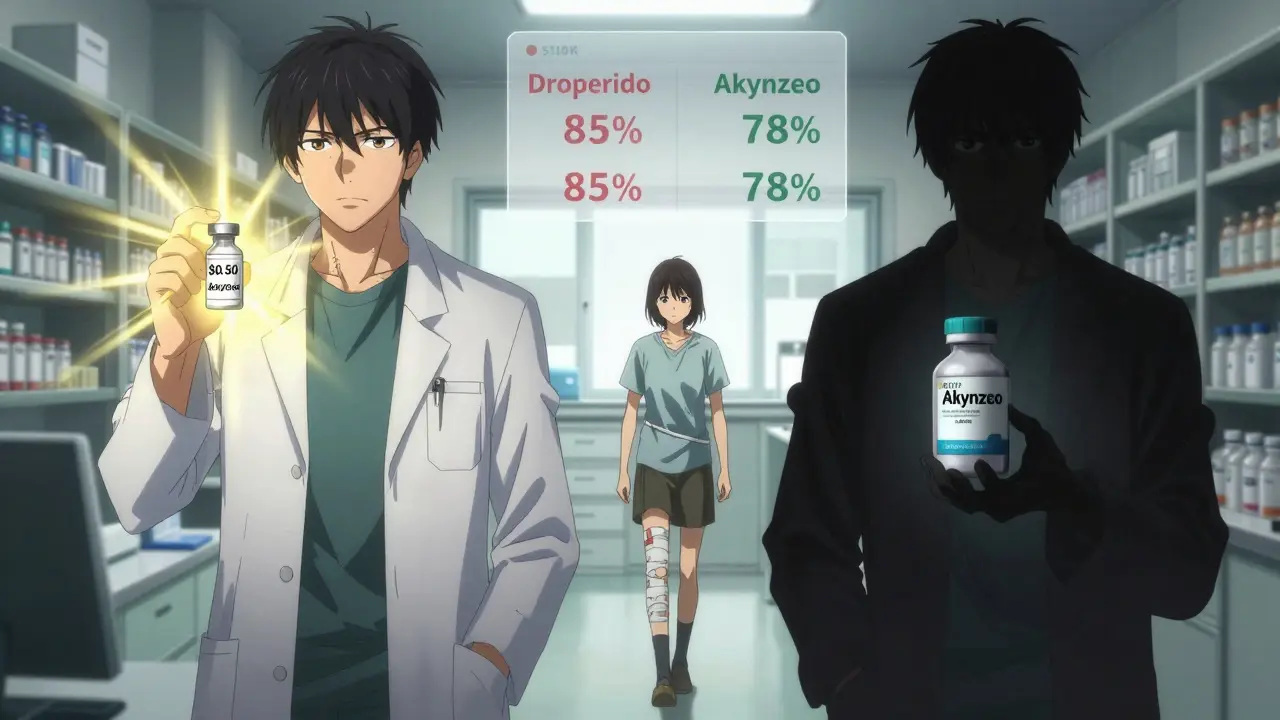
Generic ondansetron: $1.25 per 4 mg dose. Droperidol: $0.50 per dose. Dexamethasone: $0.25 per 8 mg dose. The math is clear-dopamine blockers like droperidol are far more cost-effective. But here’s the catch: droperidol has a black box warning from the FDA for QT prolongation at doses over 1.25 mg. That means an ECG is needed if you give more. Many hospitals avoid it because of paperwork, even though low doses are proven safe.
On the other hand, newer drugs like netupitant/palonosetron (Akynzeo) cost over $350 per dose. They’re powerful for chemo patients, but overkill for routine PONV. Most hospitals now use formulary guidelines to prevent overuse.
Side effects matter too. Ondansetron causes headaches in about a third of users. Metoclopramide can cause akathisia-a restless, agitated feeling-in up to 8% of elderly patients. That’s why some clinics now use olanzapine (2.5-5 mg) instead for older adults: it’s better tolerated.
How to Choose: The Apfel Risk Score
The best way to pick an antiemetic isn’t guesswork-it’s a simple scoring system called the Apfel score. It looks at four factors:
- Female sex
- Non-smoker
- History of motion sickness or past nausea after surgery
- Use of post-op opioids
Each factor = 1 point.
- 0-1 point: Low risk. No preventive meds needed. Give ondansetron only if nausea starts.
- 2 points: Moderate risk. One antiemetic: either droperidol 0.625 mg or ondansetron 4 mg.
- 3-4 points: High risk. Two drugs: droperidol + dexamethasone. This combo cuts nausea risk by over 60%.
Studies show that hospitals using this approach reduce unnecessary antiemetic use by 40%. That means fewer side effects, lower costs, and better outcomes.

What Practitioners Are Saying
Real-world experience adds nuance.
One anesthesiologist in Massachusetts reported that switching from routine ondansetron to droperidol for low-risk patients cut their antiemetic costs by 60% without increasing nausea. Another in Oregon stopped using metoclopramide altogether in patients over 65 after seeing too many cases of restlessness.
On Reddit’s r/Anesthesiology forum, nurses and doctors consistently say: "Droperidol 0.625 mg is underrated. It works fast, doesn’t make people sleepy, and costs less than a coffee." Meanwhile, patients on Drugs.com praise ondansetron for stopping nausea in minutes-but many wish they’d known about the headache risk ahead of time.
What’s New and What’s Coming
In 2024, the FDA approved intranasal ondansetron (Zuplenz), which works almost as fast as IV and is great for patients who can’t swallow pills. For chemotherapy patients, newer drugs like rolapitant (an NK-1 receptor blocker) are showing 78% success in preventing delayed nausea-better than older combos.
Future directions? Personalized medicine. Researchers are studying how genes affect how people metabolize ondansetron. Some people are slow metabolizers and get more side effects. Others clear it too fast and get no benefit. Soon, a simple genetic test could tell you which drug to use.
Final Takeaways: Choosing Safely
There’s no single best antiemetic. The right choice depends on:
- The cause of nausea (surgery? chemo? opioids?)
- The risk level (use the Apfel score)
- The cost and side effect profile
- The patient’s age and medical history
For most surgical patients: Start with droperidol 0.625 mg if they’re low to moderate risk. If they’re high risk, add dexamethasone. Use ondansetron if droperidol isn’t available or if the patient has heart issues. Avoid promethazine and scopolamine for drug-induced nausea-they’re not the right tools.
For chemo patients: Stick to 5-HT3 antagonists plus dexamethasone. For refractory cases, consider NK-1 blockers.
And always ask: Is this drug being used because it works-or because it’s what we’ve always done?
What’s the safest antiemetic for post-surgery nausea?
For most patients, low-dose droperidol (0.625 mg IV) is both safe and effective. It works faster than ondansetron, costs less, and has fewer side effects at this dose. ECG monitoring is only needed if the dose exceeds 1.25 mg. For patients with heart conditions or those who can’t get droperidol, ondansetron 4 mg IV is the next best option.
Why is dexamethasone used with other antiemetics?
Dexamethasone doesn’t work well on its own for nausea-it takes 4-5 hours to kick in. But when combined with ondansetron or droperidol, it boosts effectiveness by 20-30%. It’s especially helpful for high-risk patients and those getting opioids. It’s also cheap and has a long history of safe use in short-term doses.
Can I use ondansetron if I have a heart condition?
Use caution. Ondansetron can prolong the QT interval on an ECG, which may trigger dangerous heart rhythms in people with congenital long QT syndrome, electrolyte imbalances, or those taking other QT-prolonging drugs. Avoid it in these cases. Droperidol at low doses or metoclopramide (if kidney function is normal) are safer alternatives.
Is metoclopramide still a good choice for nausea?
Only in specific cases. Metoclopramide works best when nausea is tied to slow stomach emptying-like after abdominal surgery or in diabetic gastroparesis. But for general medication-induced nausea, it’s less effective than ondansetron or droperidol. Doses above 10 mg increase the risk of movement disorders, especially in older adults. Stick to 25 mg if you use it, and avoid it in patients over 65 unless absolutely necessary.
Are generic antiemetics as good as brand names?
Yes. Generic ondansetron, droperidol, and dexamethasone are bioequivalent to brand versions. Studies show no difference in effectiveness or side effects. The only exception is combination drugs like Akynzeo (netupitant/palonosetron), which have no generic equivalent and are only used for high-risk chemotherapy cases. For routine use, generics are the smart choice.


