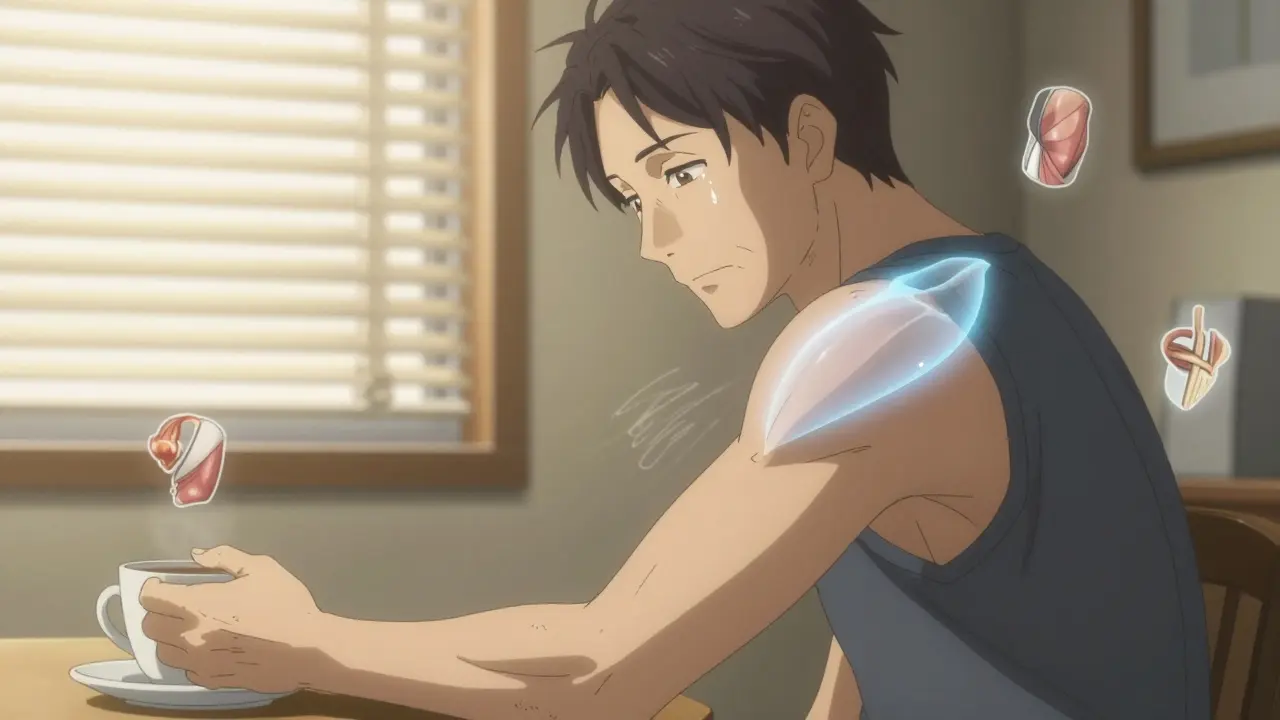
When your shoulder starts hurting every time you reach for a coffee cup or lift your arm to brush your hair, it’s not just a bad day-it might be a rotator cuff tear. This isn’t some rare sports injury. In fact, nearly half of people over 60 have a rotator cuff tear without even knowing it. The real question isn’t whether you have one, but whether it needs fixing-and how.
What Exactly Is a Rotator Cuff Tear?
The rotator cuff is a group of four tendons and muscles that wrap around the top of your upper arm bone (humerus). They hold your shoulder in place and let you lift, rotate, and reach. When one of these tendons tears, it can happen suddenly from a fall or lift, or slowly over time from wear and tear. The most common tear is in the supraspinatus is the tendon most often injured in rotator cuff tears, responsible for initiating arm lifting. But tears can also involve the infraspinatus is a rotator cuff tendon that helps with external rotation of the shoulder, teres minor is a small rotator cuff muscle that aids in shoulder rotation, or subscapularis is the front rotator cuff tendon that helps rotate the arm inward.
Not all tears are the same. Some are partial-like a frayed rope. Others are full-thickness, where the tendon is completely detached from the bone. Size matters too: small tears under 1 cm often respond well to rehab. Large tears over 3 cm? Those are trickier. And yes, you can have a big tear and still move your arm fine. That’s why symptoms don’t always match the scan.
Imaging: What’s the Best Test?
Doctors don’t just guess. They use imaging to see what’s going on inside. But not all scans are created equal.
X-rays are the first step-used in every single case. Why? Because they show bone. Are there spurs? Arthritis? A tilted shoulder blade? These can be the real cause of pain, not the tendon tear itself. But X-rays won’t show the tendon. That’s where other tests come in.
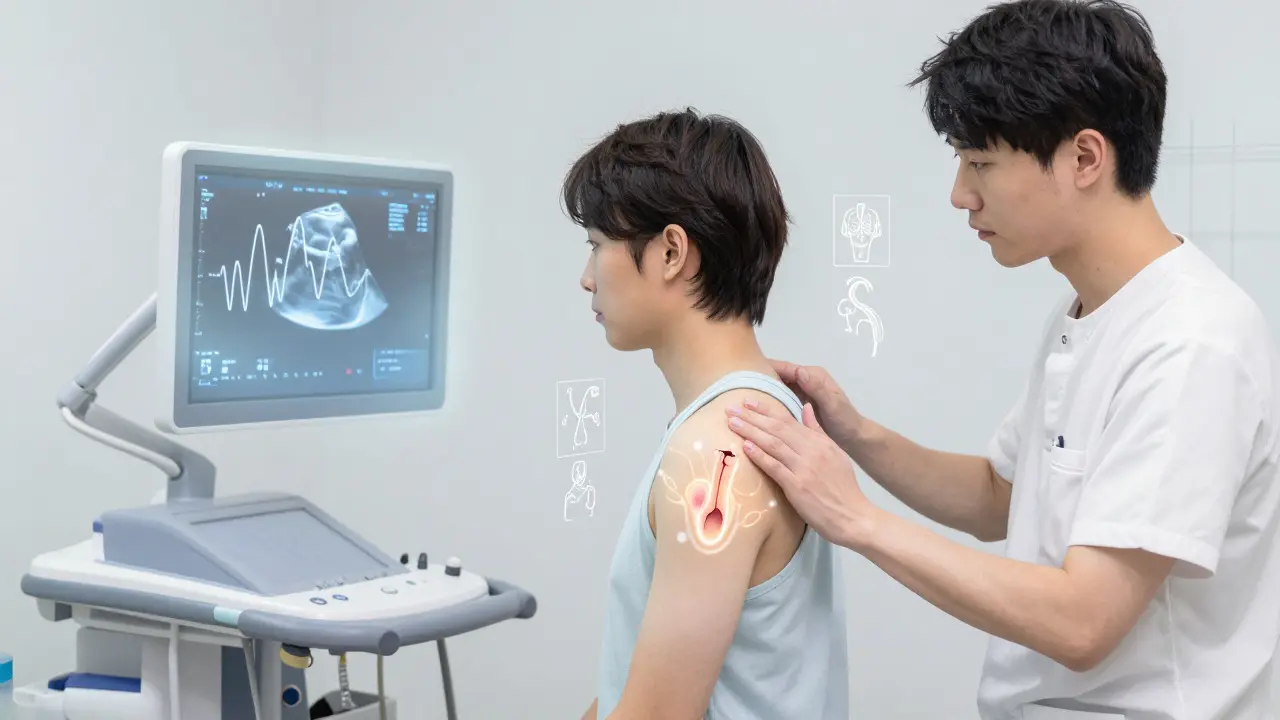
Ultrasound is quietly becoming the go-to for many clinics. It’s cheaper, faster, and you can move your shoulder while they scan it. A skilled tech can spot a full-thickness tear with 87-91% accuracy. Plus, you can compare both shoulders at once. No claustrophobia. No metal restrictions. And according to the University of Washington Orthopaedics is a leading institution that recommends ultrasound as the most efficient and cost-effective imaging method for rotator cuff evaluation, it’s often the best first test. The catch? It’s only as good as the person holding the probe. Only 45% of general radiologists have the training to do it well.
MRI gives you the full picture. It shows the tendon’s thickness, water content, and whether the tear is fresh or old. It’s 92% accurate for full-thickness tears. It’s also the only way to see if the muscle has turned to fat-a sign the tear has been there too long. But it’s expensive ($500-$1,200), takes longer, and can’t be used if you have a pacemaker or metal implants. Most MRIs for rotator cuff tears are done without contrast. Only after surgery, if the tear comes back, do they sometimes use contrast to check for re-tears.
Here’s the bottom line: If you’re under 65 and have clear signs of a tear, ultrasound is often enough. If you’re planning surgery or have a complex case, MRI is the roadmap. The American Roentgen Ray Society is a professional organization that recommends ultrasound as the initial imaging test for suspected rotator cuff pathology due to its accuracy and cost-effectiveness says ultrasound should be first. Most doctors now agree.
Rehab: Can You Fix It Without Surgery?
Here’s the surprising truth: up to 85% of people with partial-thickness tears get better with rehab alone. Even some full-thickness tears don’t need surgery-if you’re not active, don’t do heavy lifting, and your pain is manageable.
Rehab follows three clear phases:
- Weeks 1-6: Passive motion-no lifting. A therapist moves your arm for you. This keeps the joint from stiffening. Ice and anti-inflammatories help with swelling.
- Weeks 6-12: Active-assisted motion-you start moving your arm with help. Resistance bands come in. Focus is on restoring normal movement, not strength.
- After 12 weeks: Strengthening-now you build back muscle. Exercises target the rotator cuff, shoulder blades, and even your core. Bad posture? That’s part of the problem. Fix it.
Studies from the Journal of Orthopaedic & Sports Physical Therapy is a peer-reviewed journal that reports 85% of patients with partial-thickness rotator cuff tears achieve functional recovery through structured rehabilitation show that people who stick with rehab for 3-6 months usually regain 90% of their function. No surgery. No downtime. Just time and consistency.
But here’s the catch: rehab doesn’t work if you go back to lifting heavy too soon. Or if you ignore the shoulder blade muscles. Or if you skip the home exercises. It’s not magic. It’s work.
Surgery: When and How?
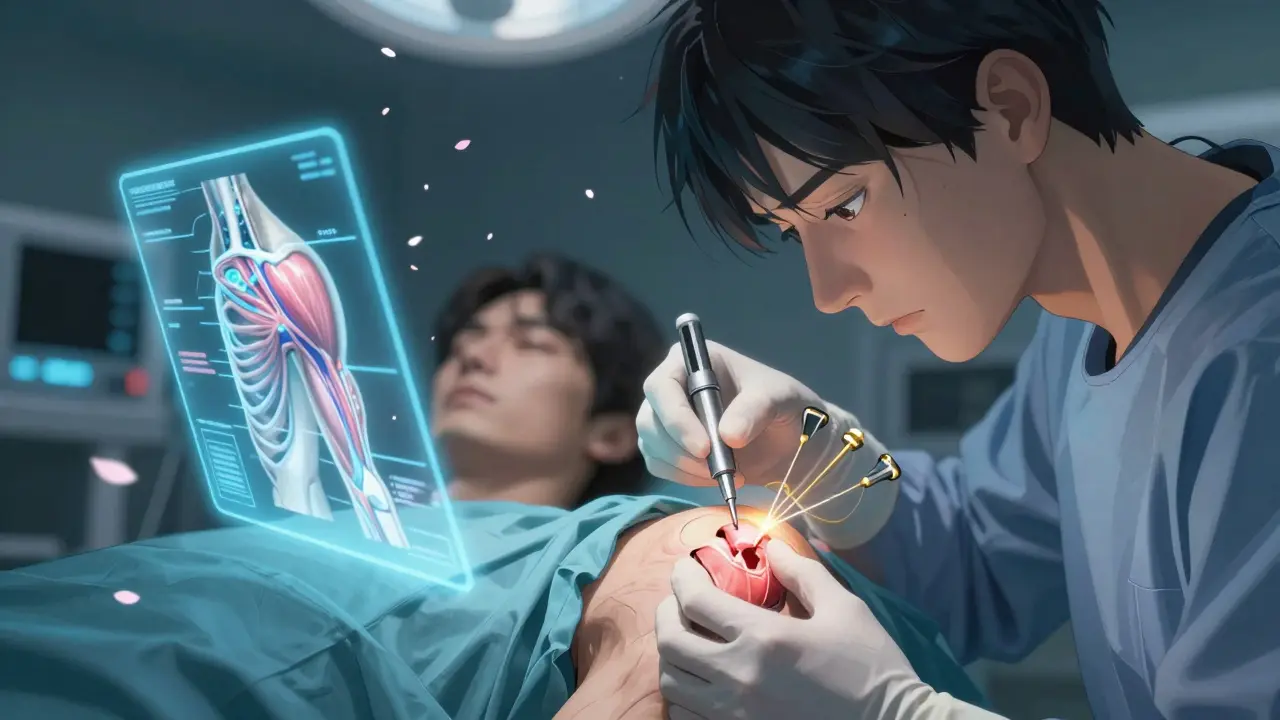
If rehab fails, or if you’re young and active with a full-thickness tear, surgery is often the next step. The most common procedure today is arthroscopic repair is a minimally invasive surgical technique using small incisions and a camera to repair rotator cuff tears. It’s used in 90% of cases.
Here’s how it works: Three tiny cuts. A camera goes in. The torn tendon is cleaned up, and stitches are anchored into the bone. The surgeon uses small devices called suture anchors-tiny screws with thread-to pull the tendon back into place. It’s done under general anesthesia and you’re usually home the same day.
Compared to old-school open surgery (a big cut, 6-inch scar), arthroscopic repair has:
- 30% fewer complications
- 25% faster return to daily activities
- Less pain and scarring
But it’s not perfect. The Journal of Bone and Joint Surgery is a leading medical journal that reports arthroscopic rotator cuff repair has equivalent functional outcomes to open repair with significantly lower complication rates found that re-tear rates are still high: 12% for small tears, 27% for large ones. That’s why timing matters. The longer you wait, the more the muscle shrinks and turns to fat. Once that happens, even perfect surgery won’t fix everything.
For massive tears (where two or more tendons are gone), surgeons now sometimes use a patch augmentation is a surgical technique using biologic or synthetic material to reinforce a large or massive rotator cuff tear-a patch stitched over the tear to help it heal. It’s not standard yet, but it’s showing promise.
What About PRP and Other New Treatments?
You’ve probably heard of platelet-rich plasma (PRP) injections. The idea: take your own blood, spin out the healing cells, and inject them into the tear. Sounds great, right?
The Cochrane Review is an independent organization that evaluates medical evidence and found only moderate evidence supporting PRP for rotator cuff tears looked at 15 studies. Result? No clear benefit over placebo. Some patients feel better. Others don’t. It’s expensive. Not covered by insurance. And it’s not proven to help the tendon heal better.
Same goes for stem cell injections. Still experimental. No long-term data. Stick with rehab and surgery if you need them.
When Should You Act?
The American Academy of Orthopaedic Surgeons is a professional organization that recommends against routine pre-operative imaging and advocates for an initial trial of physical therapy for 6-8 weeks says: try rehab first. Even if the MRI shows a tear. Why? Because many people have tears with no pain. And rehab works. Often.
But if you’re under 65, active, and your shoulder gives out when you lift your arm? Don’t wait. That tear isn’t going to heal on its own. Delaying surgery increases the chance of muscle damage you can’t fix later.
And if you’re over 60? If the pain is mild and you don’t need to lift heavy, rehab is usually enough. But if you’re losing strength, dropping things, or can’t sleep? That’s a sign to talk to a specialist.
Recovery: What to Expect
Forget the old 6-month recovery. With modern techniques, most people are back to normal daily tasks in 4-6 months. But full strength? That can take a year.
After surgery:
- Day 1-2: Arm in sling. No lifting.
- Week 1-6: Passive motion only. No pushing or pulling.
- Week 6-12: Start light active motion. Begin physical therapy.
- Week 12+: Strengthening. Return to sports or work tasks.
And here’s something most people don’t know: the American Academy of Orthopaedic Surgeons is a professional organization that recommends against routine pre-operative imaging and advocates for an initial trial of physical therapy for 6-8 weeks now says you don’t need an MRI before surgery if your exam and history clearly point to a tear. Save the scan for if rehab fails.
And yes, you can still have a good outcome even with a re-tear. Many people with a re-tear on MRI still have little to no pain. The body adapts. That’s why function matters more than the scan.
Final Thoughts
Rotator cuff tears are common. They’re not always the enemy. The goal isn’t to fix every tear-it’s to fix the ones that hurt and limit you. Imaging helps. Rehab works. Surgery saves function. But none of it matters if you don’t stick with the plan.
Don’t rush into surgery. Don’t ignore the rehab. And don’t believe every viral treatment you see online. Stick with the science. And give your shoulder time.
Can a rotator cuff tear heal without surgery?
Yes, many can-especially partial-thickness tears and in people over 60 who aren’t highly active. Studies show up to 85% of patients with partial tears improve with physical therapy alone. Full-thickness tears rarely heal on their own, but if they don’t cause pain or weakness, surgery isn’t always needed. The key is consistent rehab over 3-6 months.
Is MRI or ultrasound better for diagnosing a rotator cuff tear?
For most people, ultrasound is just as accurate as MRI for detecting full-thickness tears and is cheaper, faster, and has no contraindications. MRI gives more detail, especially for partial tears and muscle changes, and is better for surgical planning. The American Roentgen Ray Society recommends ultrasound as the first test, with MRI reserved for complex cases or when surgery is being considered.
How long does rotator cuff surgery recovery take?
Most people return to daily activities in 4-6 months. Full strength and return to heavy lifting or sports can take up to a year. Modern arthroscopic techniques allow earlier movement-many patients start passive motion the day after surgery, unlike older methods that required 6 weeks of immobilization. Adherence to rehab is the biggest factor in recovery speed.
Do I need an MRI before trying physical therapy?
No. The American Academy of Orthopaedic Surgeons recommends trying 6-8 weeks of physical therapy first, even if you have clear signs of a tear. Many people have asymptomatic tears on MRI, and rehab often resolves symptoms. Imaging is usually reserved for cases that don’t improve with therapy or when surgery is being considered.
Can you still have a good outcome after a re-tear?
Yes. Even if a follow-up MRI shows the tendon has torn again, many people have little to no pain or loss of function. The body can adapt by using other muscles to compensate. Function matters more than the scan. Surgery isn’t always needed after a re-tear-especially if you’re not in pain and can still use your arm normally.


