
When someone suddenly loses balance, slurs their words, or drops an arm, most people think it’s a stroke. But what if the symptoms vanish in minutes? Many assume it’s nothing serious - that it was just a passing spell. That’s a dangerous mistake. A TIA - transient ischemic attack - isn’t a minor issue. It’s your brain’s last cry for help before a full stroke hits. And ignoring it could cost you your life.
What Exactly Is a TIA?
A TIA happens when blood flow to part of your brain gets blocked - just like in a stroke. But here’s the difference: the blockage clears on its own, usually within minutes. Symptoms disappear. No permanent damage shows up on a brain scan. That’s why people call it a “mini-stroke.” But that term is misleading, and it’s killing people. The American Heart Association stopped using the 24-hour time rule in 2009. It’s not about how long symptoms last anymore. It’s about whether there’s brain tissue damage. If your MRI shows no infarction (dead brain cells), it’s a TIA. If it does? That’s a minor stroke. Shockingly, about 35% of people who think they had a TIA actually had a small stroke all along. Their symptoms faded, but the damage didn’t. Think of a TIA like a warning flare. It’s not the fire itself - it’s the smoke before the flames. One in five people who have a TIA will have a full stroke within 90 days. And half of those strokes happen in the first two days. That’s not a risk. That’s a countdown.How to Spot the Difference - and Why It Doesn’t Matter
The symptoms of a TIA and a stroke are identical. You can’t tell them apart by how they feel. Both can cause:- Sudden face drooping - one side of the mouth sags when smiling
- Arm weakness - inability to raise one arm, or it drifts downward
- Slurred speech - trouble speaking clearly, or words come out wrong
- Blurred or lost vision in one or both eyes
- Dizziness, loss of balance, or sudden severe headache
- Balance - sudden loss of coordination
- Eyes - vision changes
- Face - drooping
- Arm - weakness
- Speech - slurred or strange
- Time - call 911 now
Why Delaying Care Is a Deadly Gamble
Most people don’t realize how fast stroke risk spikes after a TIA. The first 48 hours are the most dangerous. Up to 5% of people have a stroke within two days. That’s higher than the risk of a car crash on a busy highway. The ABCD2 score helps doctors measure that risk. It looks at:- Age - 60 or older? Add 1 point
- Blood pressure - over 140/90? Add 1
- Clinical features - weakness on one side? That’s 2 points. Just speech trouble? 1 point
- Duration - symptoms over an hour? 2 points. 10 to 59 minutes? 1 point
- Diabetes? Add 1 point
What Happens in the ER - And Why Speed Saves Lives
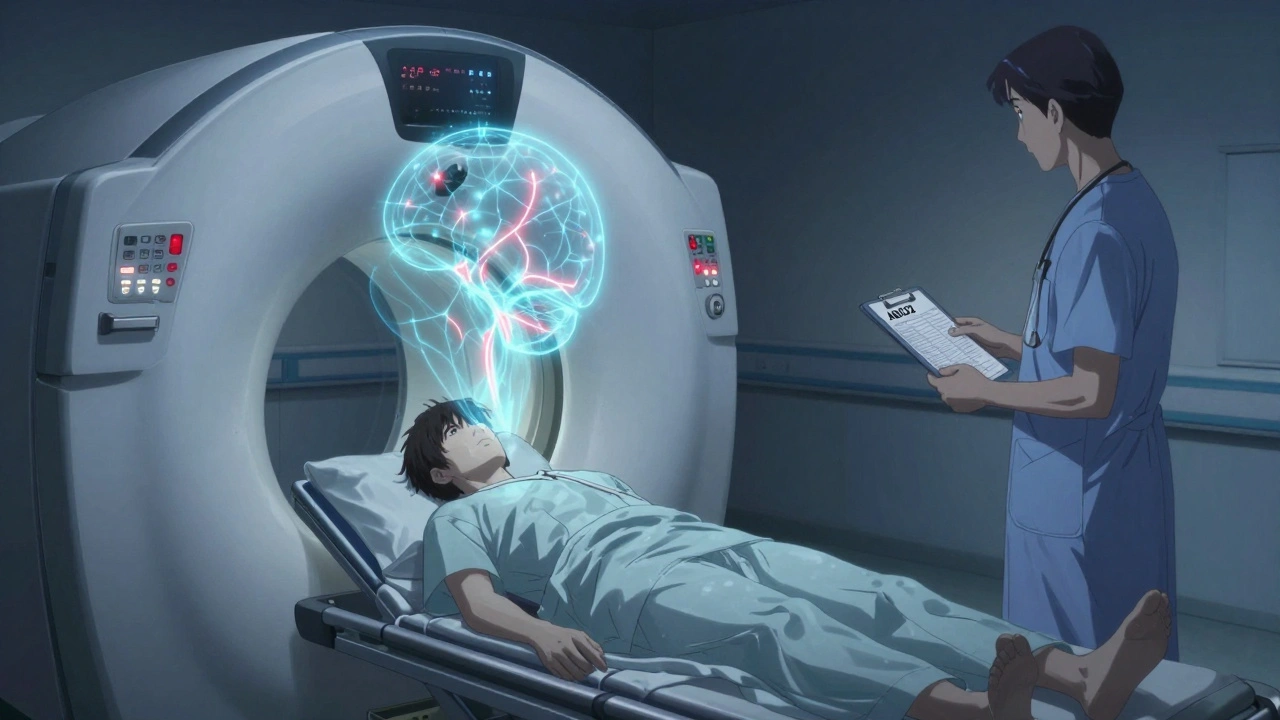
When you arrive at the hospital with suspected TIA, time is everything. The first thing they do is a non-contrast CT scan - to rule out bleeding in the brain. Then, within 24 hours, you’ll get an MRI with diffusion-weighted imaging. This scan can detect tiny areas of brain damage that a regular CT misses. That’s how they know if it was a true TIA or a minor stroke. If you’re high-risk (ABCD2 ≥4), you’ll likely be admitted. Treatment starts fast:- Aspirin 325 mg - given within 24 hours - cuts stroke risk by 60%
- Dual antiplatelet therapy - aspirin plus clopidogrel - used for 21 to 30 days
- High-intensity statin - atorvastatin 80 mg daily - to stabilize plaque in arteries
- Blood pressure control - target under 140/90
What Happens After the Emergency
The ER isn’t the end. It’s the start. After a TIA, you need long-term prevention. That means:- Checking for atrial fibrillation (a heart rhythm problem that causes clots)
- Testing for carotid artery narrowing - if it’s over 70%, you may need surgery
- Managing diabetes, cholesterol, and smoking
- Regular follow-ups with a neurologist or stroke specialist

The Bigger Picture - Why This Matters to Everyone
About 240,000 to 500,000 TIA cases happen in the U.S. every year. Only 15 to 30% of people get help right away. That’s a public health failure. Hospitals are now required to have TIA pathways. The Joint Commission demands that 90% of high-risk TIA patients be evaluated within 24 hours. CMS penalizes hospitals if more than 20% of TIA patients have a stroke within 30 days. New tools are helping. Telemedicine TIA clinics are now at 68% of major stroke centers. AI tools can predict stroke risk within seven days with 92% accuracy. Blood tests for GFAP - a protein released by damaged brain cells - could soon tell if you’ve had a TIA in 15 minutes, not 24 hours. But none of that matters if you don’t act. If you see someone with sudden symptoms - even if they fade - call 911. Don’t drive them. Don’t wait. Don’t hope it was nothing. You’re not just helping them - you’re saving their life.What to Do Right Now
If you’ve ever had symptoms like this - even once - talk to your doctor. Ask for a TIA evaluation. Get an MRI. Check your blood pressure. Know your ABCD2 score. Don’t wait for the next one. If you’re a caregiver or family member, learn BE FAST. Practice it. Know the signs. If someone you love has a TIA, don’t let them brush it off. Push for immediate care. Be the voice they can’t find when their brain is failing. A TIA isn’t a scare tactic. It’s a medical emergency. And the only thing worse than having one? Ignoring it.Is a TIA the same as a stroke?
No - but they’re caused by the same thing: a blocked blood vessel in the brain. A stroke causes permanent brain damage. A TIA doesn’t - at least not on scans. But if you’ve had a TIA, you’re at high risk for a stroke. Many people who think they had a TIA actually had a small stroke. The difference isn’t in the symptoms - it’s in the damage.
Can a TIA go away on its own?
Yes - symptoms usually disappear within minutes to an hour. But that doesn’t mean the danger is gone. The blockage may have cleared, but the underlying cause - like plaque buildup or a heart rhythm problem - is still there. That’s why you need emergency care even if you feel fine.
Do I need imaging after a TIA?
Absolutely. A CT scan rules out bleeding. But the real test is an MRI with diffusion-weighted imaging. It can find tiny areas of brain damage that CT misses. About 35% of people with suspected TIA turn out to have had a minor stroke - only found on MRI. Skipping this scan means you’re flying blind.
How soon should I get checked after TIA symptoms?
Within 60 minutes if possible. The highest stroke risk is in the first 48 hours. Hospitals with rapid TIA pathways - seeing patients the same day - cut 90-day stroke risk from over 10% to under 2%. Delaying even 24 hours can double your risk. Call 911. Don’t wait.
Is aspirin enough after a TIA?
Aspirin helps - it cuts stroke risk by 60% if taken within 24 hours. But it’s not enough alone. High-dose statins, dual antiplatelet therapy (aspirin + clopidogrel), and blood pressure control are all needed. Aspirin is just the first step. You need a full prevention plan - not just a pill.
Can I prevent a stroke after a TIA?
Yes - if you act fast. Immediate treatment cuts stroke risk by 80%. Long-term, controlling blood pressure, quitting smoking, managing cholesterol, and treating heart conditions like atrial fibrillation can reduce your risk by more than 70%. A TIA isn’t a death sentence - it’s a wake-up call. And you have the power to respond.
Why do people ignore TIA symptoms?
Because they think, “It went away, so it wasn’t serious.” That’s the myth. The truth? Symptoms disappearing is exactly why it’s so dangerous. It tricks you into thinking you’re safe. But the damage is still coming. Over 30% of people wait more than a day to get help - and that delay costs lives.


