Methadone QT Prolongation Risk Calculator
Personal Health Assessment
Why Methadone Can Slow Your Heart’s Electrical System
Methadone saves lives. For people struggling with opioid dependence, it reduces cravings, cuts overdose deaths by a third, and helps rebuild stability. But behind that benefit is a quiet, dangerous side effect: methadone QT prolongation. It doesn’t cause dizziness or nausea. It doesn’t show up in urine tests. It hides in the ECG-a simple, painless heart tracing that many patients never get.
When methadone blocks the hERG potassium channels in your heart, it delays the electrical reset between beats. That delay shows up as a longer QT interval on the ECG. If it stretches too far-past 450 ms in men, 470 ms in women-it can trigger a deadly rhythm called Torsades de Pointes. It’s rare. But when it happens, it’s often sudden. And too often, it’s mistaken for an overdose.
Who’s at Risk? It’s Not Just About the Dose
Many assume that if you’re on a low methadone dose, you’re safe. That’s not true. A 68-year-old woman on 80 mg/day with low potassium and taking an antidepressant has a higher risk than a 30-year-old man on 150 mg/day with no other issues.
Here’s what actually matters:
- Gender: Women are 2.5 times more likely to develop dangerous QT prolongation.
- Age: Risk jumps after 65. Older hearts don’t handle drug stress as well.
- Electrolytes: Potassium below 3.5 mmol/L or magnesium below 1.5 mg/dL doubles the risk.
- Other meds: Antidepressants like amitriptyline, antipsychotics like haloperidol, and antibiotics like moxifloxacin can stack on methadone’s effect.
- Heart disease: If you’ve had a heart attack, heart failure, or have a weak pumping muscle (ejection fraction under 40%), your risk spikes.
- Drug interactions: Fluconazole, voriconazole, or fluvoxamine can spike methadone levels by 50%-and so can your QT interval.
A 2017 study of 127 people in a Swiss hospital found that 28% had dangerous QT prolongation. The top three predictors? Daily methadone dose over 100 mg, low potassium, and taking another psychotropic drug. Dose alone isn’t the villain. It’s the combo.
When and How Often Should You Get an ECG?
Not everyone needs an ECG every month. But skipping it entirely is dangerous. Guidelines agree: baseline ECG is non-negotiable.
Here’s the real-world roadmap:
- Before you start: Get an ECG. Measure the QTc. Write it down. This is your starting line.
- At steady state: Wait 2-4 weeks after starting methadone or changing your dose. That’s when levels stabilize. Get another ECG.
- Then, based on risk:
| Risk Level | QTc Criteria | Other Risk Factors | Monitoring Frequency |
|---|---|---|---|
| Low | <450 ms (men), <470 ms (women) | None | Every 6 months |
| Moderate | 450-480 ms (men), 470-500 ms (women) | One or two risk factors (e.g., age, low potassium, one interacting drug) | Every 3 months |
| High | >480 ms (men), >500 ms (women) | Three or more risk factors | Monthly; consider dose reduction or switch to buprenorphine |
If your QTc jumps more than 60 ms from baseline-or hits 500 ms or higher-you need urgent action: check electrolytes, review all meds, and talk to a cardiologist. Buprenorphine is a safer alternative for many, with far less QT risk.
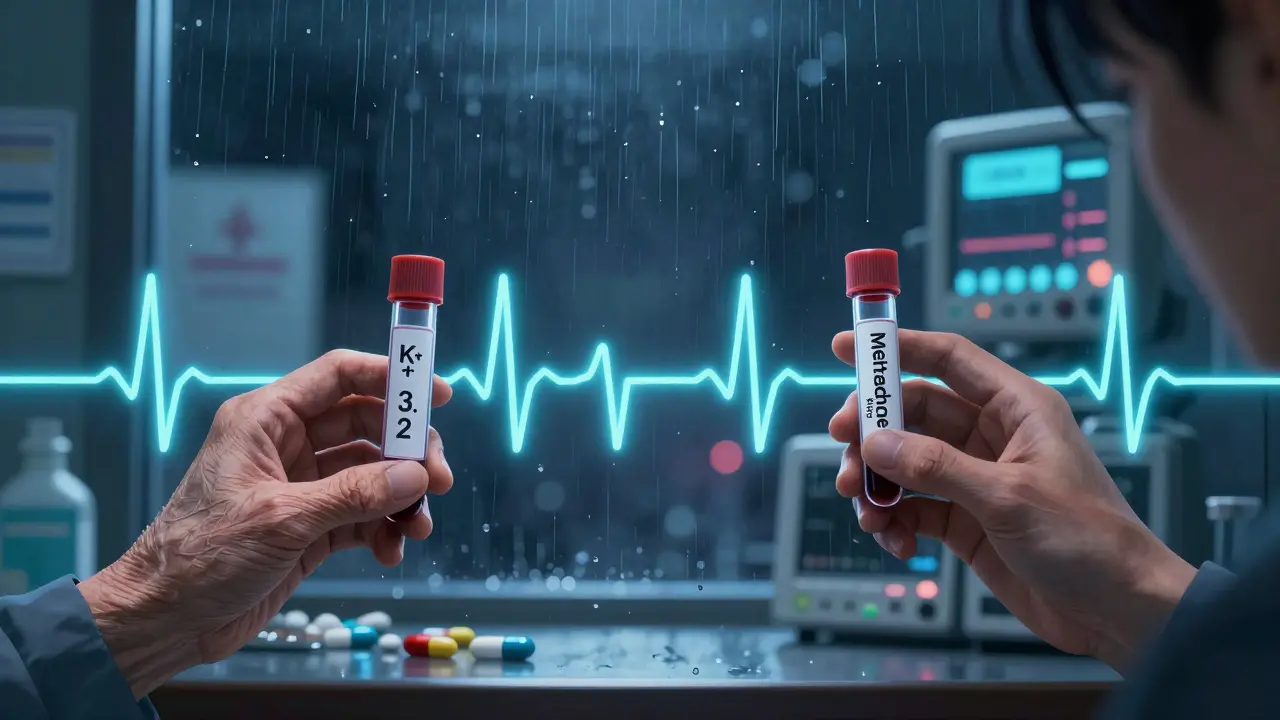
What Happens If You Ignore This?
In 2023, a study in JAMA Internal Medicine tracked methadone clinics that started routine ECG monitoring versus those that didn’t. The result? A 67% drop in serious heart events. That’s not a small win. That’s life or death.
Between 2000 and 2022, the FDA logged 142 confirmed cases of Torsades de Pointes tied to methadone. But experts believe that’s a fraction of the real number. In addiction treatment settings, sudden death is often blamed on overdose-even when the person had no drugs in their system. The heart just stopped. Because the QT interval had stretched too far.
And here’s the cruel twist: sleep apnea affects about half of people on methadone. Every time you stop breathing at night, your oxygen drops. That stresses your heart. It makes QT prolongation worse. Yet, few clinics screen for it.
What You Can Do Right Now
If you’re on methadone:
- Ask for your last ECG result. Don’t wait for them to offer it.
- Know your potassium level. If it’s below 4 mmol/L, ask your doctor why.
- Review every medication you take-even OTC ones. Cold pills with antihistamines? Antidepressants? They can push you over the edge.
- If you feel faint, dizzy, or have palpitations, get an ECG immediately. Don’t wait.
- Track your dose. If you’ve been on over 100 mg/day for months without an ECG, schedule one now.
Patients on Reddit’s r/OpiatesRecovery community say 68% of clinics don’t have consistent ECG protocols. But those who got regular monitoring were 82% more confident in their safety. Knowledge isn’t just power-it’s protection.
What Clinics Should Be Doing
Not every clinic has a cardiologist on staff. But every clinic can have a protocol.
- Make baseline ECG part of intake paperwork.
- Set up automatic alerts when a patient’s QTc exceeds 450 ms (men) or 470 ms (women).
- Train staff to check electrolytes before dose increases.
- Keep a list of QT-prolonging drugs and cross-check every new prescription.
- Refer anyone with QTc >500 ms or a 60+ ms increase to cardiology within 48 hours.
There’s no excuse for not doing this. The data is clear. The guidelines are established. The tools are cheap and widely available.
Is There a Safer Alternative?
Buprenorphine is the most common alternative. It’s just as effective for most people, with a fraction of the QT risk. Studies show its QTc prolongation is minimal-even at high doses. If you’re on high-dose methadone and have multiple risk factors, switching isn’t giving up-it’s upgrading your safety.
Some patients worry buprenorphine won’t control cravings as well. But for most, it does. And if it doesn’t, combining it with counseling or naltrexone can help. The goal isn’t just to stay off opioids. It’s to stay alive.
Final Thought: This Isn’t Just a Medical Issue
Methadone is a lifeline. But it’s also a landmine if you don’t know where the wires are. The fact that so many patients go months-or years-without an ECG isn’t negligence. It’s ignorance. And ignorance kills.
Every time someone on methadone dies suddenly, ask: Did they get an ECG? Was their potassium checked? Were their meds reviewed? If the answer is no, then their death wasn’t inevitable. It was preventable.
How do I know if my QT interval is prolonged?
Your QT interval is measured on an ECG and corrected for heart rate (called QTc). Normal is ≤430 ms for men and ≤450 ms for women. Borderline is 431-450 ms (men) or 451-470 ms (women). Clinically significant prolongation is >450 ms in men or >470 ms in women. If your QTc is above 500 ms, it’s considered dangerous and needs immediate attention.
Can I still take methadone if I have a prolonged QT interval?
Yes, but only with strict monitoring. If your QTc is between 450-480 ms (men) or 470-500 ms (women), you can continue methadone with monthly ECGs and correction of electrolytes. If it’s over 500 ms or has increased by more than 60 ms from baseline, your dose should be reduced or switched to buprenorphine. Never ignore a prolonged QTc-it’s a warning sign, not a footnote.
Does every methadone patient need an ECG?
Yes, at least once-before starting or after a dose increase. The American College of Cardiology recommends baseline ECG for all patients starting methadone at doses over 100 mg/day. For lower doses, an ECG is still advised if you have any risk factors like age, female gender, low potassium, heart disease, or are taking other QT-prolonging drugs. Skipping the first ECG is like driving without checking your brakes.
What medications should I avoid while on methadone?
Avoid drugs that also prolong QT or raise methadone levels. These include: tricyclic antidepressants (e.g., amitriptyline), antipsychotics like haloperidol or ziprasidone, antibiotics like moxifloxacin or erythromycin, antifungals like fluconazole or voriconazole, and some SSRIs like fluvoxamine. Always check with your pharmacist or prescriber before starting any new medication-even over-the-counter cough syrups or sleep aids.
Can low potassium cause QT prolongation even if I’m not on methadone?
Yes. Low potassium (hypokalemia) is one of the most common causes of QT prolongation, regardless of methadone use. It’s why doctors check electrolytes before increasing methadone doses. If your potassium is below 3.5 mmol/L, your heart’s electrical system becomes unstable. Fixing it can reverse QT prolongation-sometimes in just a few days.
Is buprenorphine really safer for the heart?
Yes. Multiple studies show buprenorphine causes minimal or no QT prolongation-even at high doses. Unlike methadone, it doesn’t strongly block the hERG potassium channel. It’s become the preferred first-line treatment for many patients with heart risks, older adults, or those on multiple medications. Switching doesn’t mean you’re less committed to recovery-it means you’re protecting your heart.
How often should I get my potassium checked?
At least every 3 months if you’re on methadone. If you’re high-risk-over 65, on high doses, taking interacting drugs, or have a history of low potassium-check it every month. Potassium levels can drop fast due to vomiting, diarrhea, diuretics, or even poor diet. It’s a simple blood test that prevents cardiac arrest.
Can sleep apnea make methadone heart risks worse?
Absolutely. About half of people on methadone have undiagnosed sleep apnea. Every time you stop breathing, your oxygen drops, your heart rate fluctuates, and your body releases stress hormones. This can trigger dangerous heart rhythms, especially if your QT interval is already prolonged. If you snore loudly, wake up gasping, or feel exhausted during the day, ask for a sleep study.


