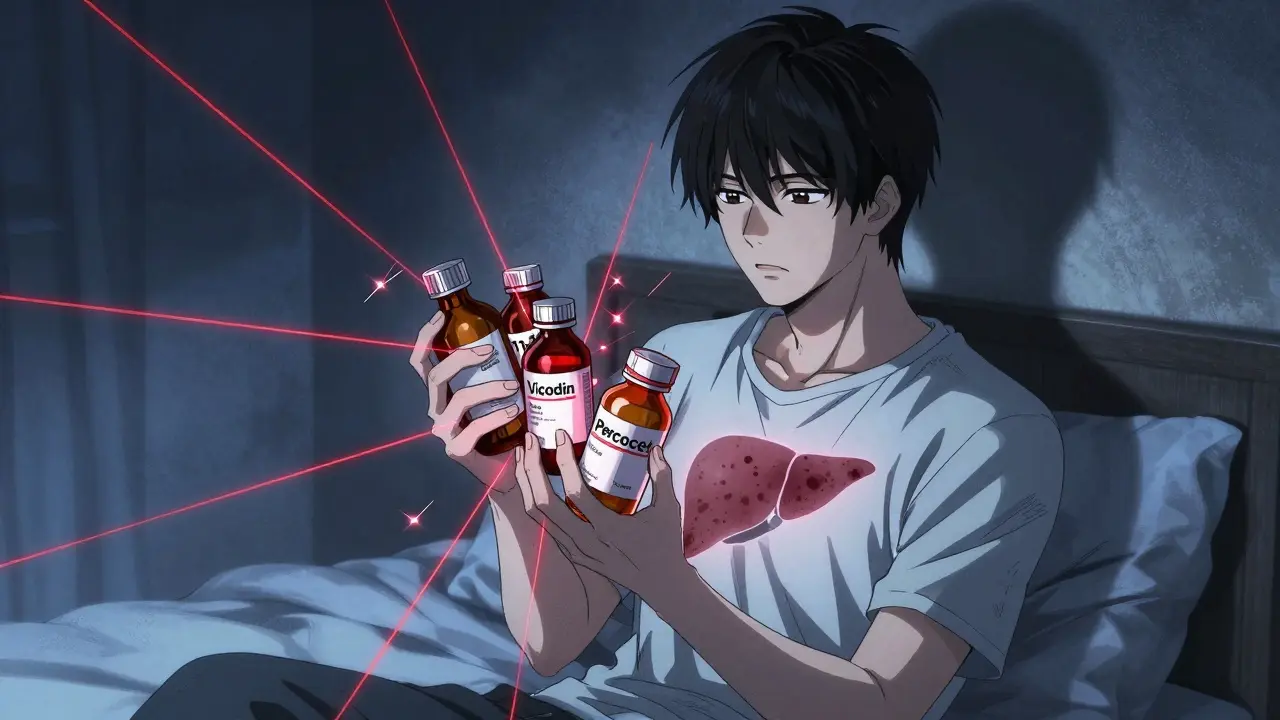
Many people don’t realize that their everyday painkillers might be quietly damaging their liver. Acetaminophen is in more than 600 medications-prescription and over-the-counter-and it’s often hidden in combination products like Vicodin, Percocet, and Tylenol Cold. You take one for a headache, another for back pain, maybe a third for a cold. All seem harmless. But together, they can push you past the safe limit of 4,000 mg a day-and that’s when your liver starts to die.
Why Combination Products Are So Dangerous
The real problem isn’t acetaminophen itself. It’s that people don’t know they’re taking it more than once. A prescription for hydrocodone/acetaminophen might say “take one tablet every 6 hours.” That’s 325 mg of acetaminophen per pill. But if you also take Tylenol for a fever, or a sleep aid with acetaminophen, you could easily hit 6,000 mg in a day. That’s 50% over the safe limit. The FDA cracked down in 2014, forcing prescription combo products to cap acetaminophen at 325 mg per dose. But that didn’t fix everything. A 2019 study in Hepatology found that 27% of all acetaminophen-related liver injuries still came from these combo drugs. And 68% of those cases were unintentional. People weren’t trying to overdose. They just didn’t know.How Acetaminophen Destroys the Liver
Your liver normally breaks down acetaminophen safely using two main pathways: glucuronidation and sulfation. But when you take too much, those pathways get overwhelmed. The extra acetaminophen gets turned into a toxic byproduct called NAPQI. Normally, your liver has enough glutathione to neutralize it. But when glutathione drops below 30% of normal, NAPQI starts attacking liver cells. This triggers a chain reaction: mitochondrial damage, oxidative stress, and activation of JNK proteins that make the injury worse. By the time symptoms like nausea, vomiting, or yellow skin appear, the damage is already advanced. In severe cases, it leads to acute liver failure. In the U.S., acetaminophen is still the top cause of sudden liver failure-more than alcohol, viruses, or autoimmune diseases.Who’s at Highest Risk?
Not everyone reacts the same way. Some people are more vulnerable:- People who drink alcohol regularly-even a few drinks a day-deplete glutathione, making them more sensitive to even normal doses.
- Those with malnutrition or eating disorders have lower glutathione stores.
- Older adults process drugs slower, so acetaminophen builds up.
- People taking multiple medications for chronic pain or insomnia often stack acetaminophen without realizing it.

What You Can Do to Stay Safe
The good news? Almost all acetaminophen liver injuries are preventable. Here’s how:- Check every pill label. Look for “acetaminophen,” “APAP,” or “paracetamol.” If you see it, count it. Don’t assume it’s only in Tylenol.
- Write down everything you take. Keep a list of all medications-prescription, OTC, supplements. Check it every time you refill a prescription.
- Never mix painkillers without asking. If you’re on a prescription combo, don’t add another pain reliever unless your doctor says it’s safe.
- Use apps or tools to track your intake. New smartphone apps can scan barcodes on medicine bottles and calculate your total daily acetaminophen. One beta-tested app from the Acetaminophen Hepatotoxicity Prevention Consortium was 89% accurate across 150 products.
- Ask your pharmacist. Pharmacists are trained to catch these overlaps. A 2021 study showed pharmacist-led counseling cut unintentional overdoses by 41%.
What Doctors and Pharmacies Are Doing
Health systems are waking up. In 2022, the CDC urged all electronic health record systems to track acetaminophen across all prescriptions. Today, 87% of Epic EHR systems do this automatically. If you’re prescribed a combo drug, your doctor’s system might flag it if you’re already taking another acetaminophen product. Pharmacies now put bright red warnings on combo product boxes. One Amazon review from March 2023 said, “The new red warning made me check all my meds-and I realized I was doubling up. I stopped before it was too late.” In the EU, pharmacists are required to counsel patients on acetaminophen risks before dispensing combo drugs. Since 2017, hospitalizations from acetaminophen liver injury have dropped 31% there.
What to Do If You Think You’ve Overdosed
If you’ve taken too much acetaminophen-even if you feel fine-act fast. The antidote, N-acetylcysteine (NAC), works best if given within 8 hours. It rebuilds glutathione and protects mitochondria. A 2009 study showed NAC given 1.5 hours after overdose reduced liver damage by 46%. Even after 24 hours, it still helps. A newer treatment, fomepizole, was approved by the FDA in 2021. It blocks the enzyme that turns acetaminophen into NAPQI. In trials, it cut severe liver injury by 32% when given within 12 hours. Don’t wait for symptoms. If you suspect an overdose, go to the ER or call poison control immediately. The Rumack-Matthew nomogram, used in hospitals, tells doctors exactly when to start treatment based on your blood level and time since ingestion.The Bigger Picture: Why Education Still Fails
Despite all the rules and warnings, a 2021 Consumer Reports survey found only 37% of people knew acetaminophen was the active ingredient in Tylenol. Just 28% knew the daily limit. On Reddit, a 2022 thread asking “How many people know their painkiller has acetaminophen?” got over 1,200 replies-68% admitted they’d taken multiple acetaminophen products at once. Language barriers make it worse. Spanish-speaking patients are 2.3 times more likely to overdose unintentionally. That’s why the FDA now offers medication guides in 14 languages. And here’s the hardest truth: adding protective chemicals to pills won’t fix this. Some researchers have proposed adding compounds like sulforaphane to boost liver defenses. But experts like Dr. Neil Kaplowitz warn: “It creates false security. People think they’re protected, so they take more.” The only real solution? Education. Knowing what’s in your medicine. Asking questions. Tracking your doses.Final Advice: One Simple Habit
Before you take any new medication-prescription or OTC-ask yourself: “Does this contain acetaminophen?” Then check your other meds. If yes, don’t take another one. If you’re unsure, call your pharmacist. It takes 30 seconds. It could save your life. The numbers are clear: 84 million opioid/acetaminophen prescriptions were filled in 2022-down from 147 million in 2010. That’s progress. But thousands still end up in the hospital every year from something that’s entirely preventable. You don’t need a miracle drug. You just need to know what’s in your medicine cabinet.Can I take acetaminophen if I drink alcohol?
If you drink alcohol regularly-even just a few drinks a week-you should limit acetaminophen to no more than 2,000 mg per day. Alcohol depletes glutathione, your liver’s main defense against acetaminophen toxicity. Even a single night of heavy drinking can make you vulnerable to overdose from a normal dose. If you’re unsure, talk to your doctor.
What are the signs of acetaminophen liver damage?
Early signs include nausea, vomiting, loss of appetite, and abdominal pain-often mistaken for the flu. After 24 to 48 hours, you may develop jaundice (yellow skin or eyes), dark urine, confusion, or extreme fatigue. By the time symptoms show up, liver damage is often advanced. If you suspect an overdose, don’t wait for symptoms-get help immediately.
Is it safe to take acetaminophen for a week straight?
Taking the maximum daily dose (4,000 mg) for more than a few days increases your risk, especially if you’re taking other medications or have liver risk factors. For long-term pain, talk to your doctor about alternatives. There’s no safe long-term use of high-dose acetaminophen. Even 3,000 mg daily for weeks can raise liver enzymes in some people.
Can I use NAC at home to prevent liver damage?
NAC is not approved for routine prevention. It’s only used as a treatment after an overdose has occurred. Taking it daily as a supplement isn’t proven to protect your liver from acetaminophen. In fact, high doses can cause side effects like nausea and diarrhea. Only take NAC under medical supervision after a known overdose.
Are generic painkillers safer than brand names?
No. Generic versions contain the same active ingredients as brand names. A generic hydrocodone/acetaminophen pill has the same amount of acetaminophen as Vicodin. Always check the label for “acetaminophen” or “APAP,” regardless of the brand. The danger comes from the ingredient, not the name on the bottle.
What should I do if I accidentally took too much?
Call poison control immediately at 1-800-222-1222 (U.S.) or go to the nearest emergency room. Do not wait for symptoms. Bring the medication bottle with you. Time is critical-treatment is most effective within 8 hours of ingestion. Even if you feel fine, get checked.


