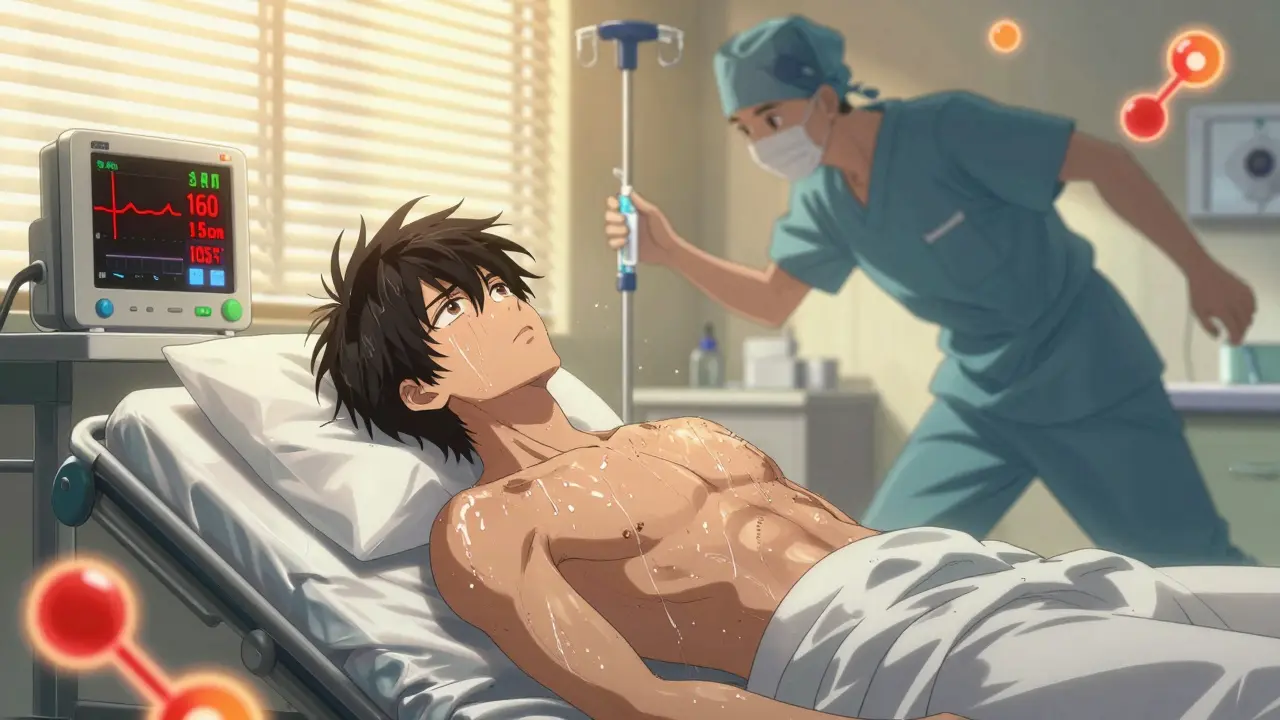
Thyroid storm isn’t just a bad case of hyperthyroidism. It’s a full-body meltdown triggered by runaway thyroid hormones, and it kills without quick intervention. If you’ve ever heard someone say, "They just got really sick all at once," and it turned out to be thyroid storm, you’re not alone. This isn’t rare in the grand scheme - it hits about 0.2 people per 100,000 each year - but when it does happen, it’s often too late before anyone realizes what’s going on. The key? Knowing the signs before it’s too late.
What Exactly Is Thyroid Storm?
Thyroid storm, also called thyrotoxic crisis, happens when someone with untreated or poorly controlled hyperthyroidism suddenly spirals into a state of extreme metabolic chaos. The thyroid gland is pumping out way too much T3 and T4 - the hormones that control how fast your cells burn energy. In normal hyperthyroidism, you might feel jittery, lose weight, or have a fast heartbeat. In thyroid storm, your body doesn’t just speed up - it breaks down.
Think of it like a car engine revving at 10,000 RPM with no brakes. Your heart races past 140 beats per minute. Your temperature spikes to 104°F or higher. You sweat through clothes, shake uncontrollably, and your mind starts slipping - confusion turns to delirium, then coma. Liver function crashes. Diarrhea hits hard. Blood pressure swings wildly. This isn’t a theory. It’s a measurable crisis with clear lab values: free T4 levels more than 2.5 times the upper limit, T3 over 3 times normal. And without treatment, death is almost certain.
What Triggers It?
Thyroid storm doesn’t come out of nowhere. It’s usually the result of something pushing an already unstable system over the edge. In 60 to 70% of cases, it’s because someone stopped their anti-thyroid meds - maybe they felt fine and thought they didn’t need them anymore. In 20 to 30%, it’s an infection - pneumonia, flu, even a urinary tract infection. Surgery, trauma, or a hard emotional shock can do it too. One documented case involved a patient who got punched in the throat and went into storm within hours.
Pregnancy is another big trigger, especially in the first few weeks after delivery. Postpartum thyroiditis can sneak up on new moms, and if they’re not monitored, it can escalate fast. Even radioactive iodine treatment - meant to calm the thyroid - can trigger storm in about 1 to 2% of cases, usually a week after the dose. The body doesn’t respond to the treatment gently; it reacts with a massive hormone dump.
The common thread? Stress. Physical, emotional, or medical - any major stressor in someone with uncontrolled hyperthyroidism is a potential fuse. That’s why patients with Graves’ disease need to be watched closely, even when they seem stable.
How Do Doctors Know It’s Thyroid Storm?
There’s no single test that says "thyroid storm." Diagnosis is based on symptoms, lab results, and a scoring system called the Burch-Wartofsky Point Scale. If your score hits 45 or higher, you’re in storm. Here’s what they look for:
- Fever: 104°F to 106°F (40°C to 41.1°C), with heavy sweating
- Tachycardia: Heart rate over 140 bpm - sometimes over 180
- CNS changes: Agitation, confusion, hallucinations, seizures, or coma (present in 90% of cases)
- Gastrointestinal issues: Nausea, vomiting, diarrhea (50-60% of patients)
- Heart failure: Fluid backing up in lungs, low blood pressure, rapid breathing
- Liver trouble: Jaundice, bilirubin over 3 mg/dL
Doctors will run a full panel: free T4, free T3, TSH (which will be undetectably low), liver enzymes, kidney function, blood gases, and a complete blood count. If you’re in the ICU with a fever of 105°F, a heart rate of 160, and you’re not making sense - and you have a history of Graves’ disease - you’re not guessing. You’re treating.
ICU Treatment: The Race Against Time
Every minute counts. Treatment starts within the first hour. Delay by even 12 hours cuts survival chances in half. The goal? Stop hormone production, block hormone action, reduce conversion to the active form, and calm the body’s response.
First: Antithyroid drugs. Methimazole (60-80 mg loading dose) or propylthiouracil (PTU - 600-1,000 mg) shuts down new hormone production. PTU is preferred in storm because it also blocks T4 from turning into T3 - the more potent hormone.
Second: Iodine. Potassium iodide (500 mg every 6 hours) or sodium iodide (1 g daily) is given after the antithyroid drug. It blocks the thyroid from releasing more hormones. Giving it too early makes things worse.
Third: Beta-blockers. Propranolol is the go-to. It doesn’t lower hormone levels, but it slams the brakes on the heart and nervous system. Doses start at 60-80 mg every 4-6 hours, or IV pushes of 1-2 mg every 5 minutes if the heart rate is sky-high. This alone can make someone feel like they’re breathing again.
Fourth: Steroids. Hydrocortisone (100 mg IV every 8 hours) prevents adrenal failure - which often happens in storm - and also helps block T4 to T3 conversion.
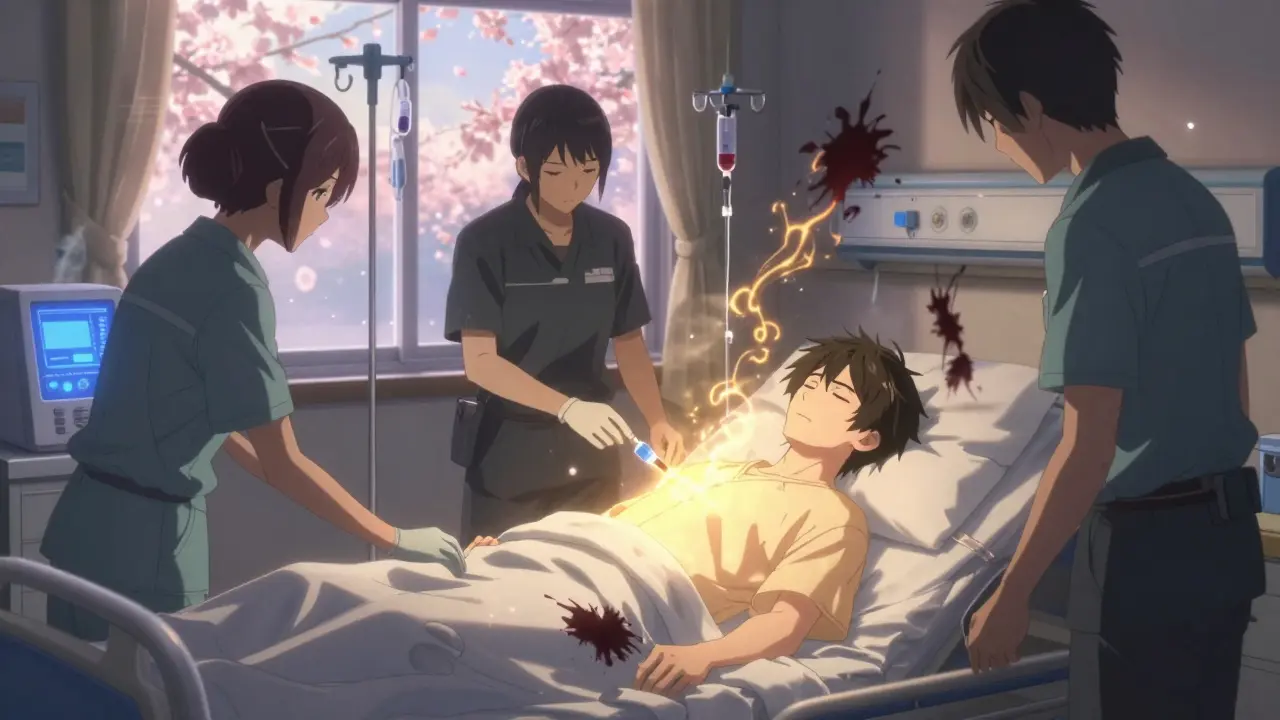
Fifth: Support. Cooling blankets for fever. IV fluids to fix dehydration from sweating and diarrhea. Acetaminophen - never ibuprofen or aspirin, which can worsen liver stress. Mechanical ventilation if breathing fails. Vasopressors if blood pressure crashes. Continuous ECG monitoring. Neuro checks every hour.
In extreme cases, doctors may use plasmapheresis - literally filtering the blood to remove excess hormones. A 2021 study showed 78% success in patients who didn’t respond to drugs alone. It’s not standard, but it’s a lifeline when everything else fails.
Survival and Recovery
Even with the best care, 8 to 25% of patients die. The odds get worse if you’re over 60, have heart disease, or your temperature climbs above 105.8°F. Coma means a 35% chance of death. Systolic blood pressure below 90? That’s a 50% mortality rate.
But here’s the hopeful part: if treatment starts within 6 hours, survival jumps to 75-80%. That’s the difference between a near miss and a full recovery. Patients who make it through usually spend 7-8 days in the ICU and another week or more in the hospital. Many need mechanical ventilation for 5 days on average.
Neurological recovery follows a pattern. Agitation fades in 24-48 hours. Confusion clears by day 3. Full mental clarity takes 7-14 days. Physical recovery is slower - fatigue lasts weeks. But the real long-term issue? The thyroid is usually destroyed.
Eighty-five percent of survivors need lifelong thyroid hormone replacement. The underlying hyperthyroidism - whether from Graves’ disease or a toxic nodule - is often permanently treated with radioactive iodine or surgery. The remaining 15% may go into remission with meds, but they’re watched like hawks. If they skip a dose, storm can return.
What Happens After?
Recovery isn’t over when you leave the hospital. Follow-up is non-negotiable. A patient who misses one endocrinologist appointment is at 25-30% risk of another storm. Those who stick to their meds, get regular blood tests, and know the warning signs? Their recurrence risk drops to 2-3%.
That’s why education matters. Programs like the American Association of Clinical Endocrinologists’ Thyroid Storm Awareness Program have cut delayed diagnoses by 18% since 2020. Patients now know: if you have hyperthyroidism and suddenly feel like you’re burning up, your heart is going to explode, and your head is spinning - don’t wait. Don’t call your doctor tomorrow. Go to the ER now.
There’s no home remedy. No herbal tea. No rest and hydration will fix this. It’s a medical emergency that needs ICU-level care - fast.
Who’s at Risk?
Anyone with untreated or poorly managed hyperthyroidism. That’s mostly people with Graves’ disease - the most common cause. Women are 5 to 10 times more likely than men to develop hyperthyroidism, and therefore, thyroid storm. Young adults and middle-aged women are most commonly affected. But it can strike anyone - even children, though it’s rare.
If you’ve had radioactive iodine treatment, surgery, or started new thyroid meds, watch for sudden changes. If you’ve been sick with a fever or infection and suddenly feel worse - not just tired, but terrified, hot, racing - tell your provider immediately.
And if you’re a caregiver for someone with thyroid disease? Learn the signs. Keep their meds organized. Don’t let them skip doses. A single missed pill can be the spark.
Final Thought: Speed Saves Lives
Thyroid storm is rare, but it’s not mysterious. We know how to treat it. We know what triggers it. We know who’s at risk. What we don’t always have is time. The difference between life and death isn’t the drug you give - it’s how soon you give it.
Know the signs. Act fast. Don’t wait for confirmation. If you suspect it - treat it like it’s real.


