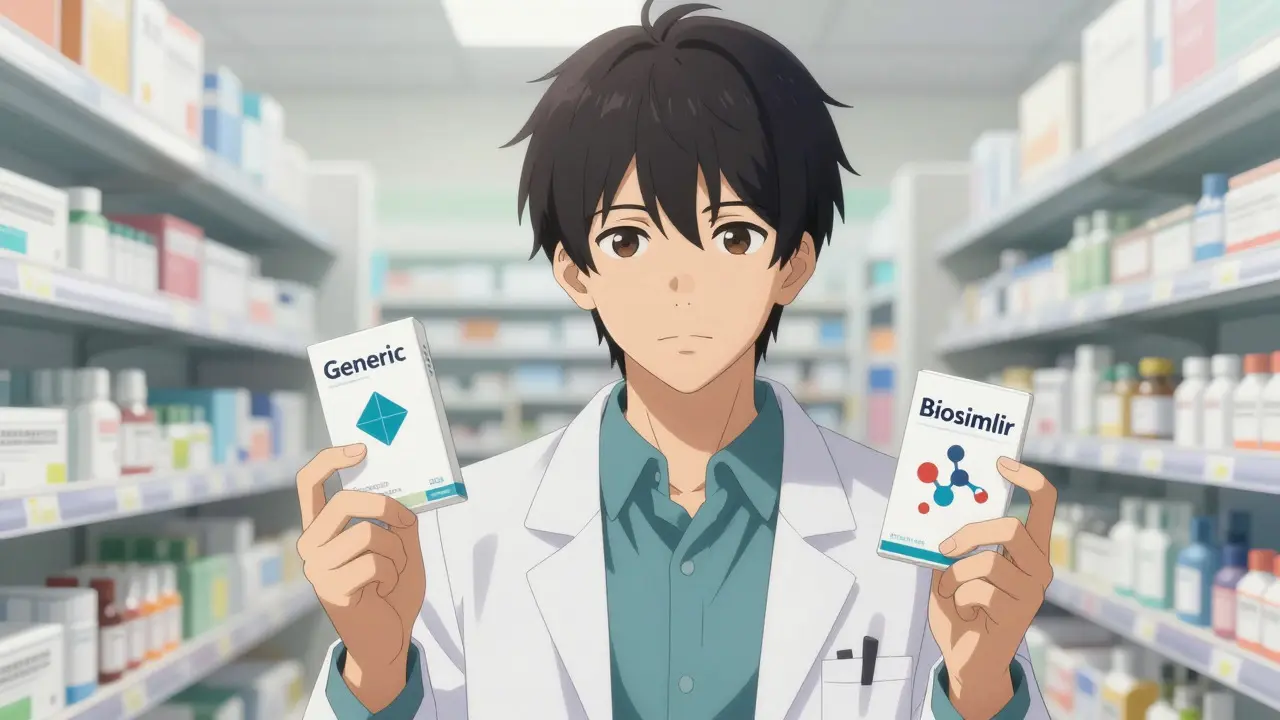
You’ve just received a prescription for a high-cost medication. Your doctor mentions that there are cheaper alternatives available-either a generic version or a biosimilar. But which one should you choose? The answer isn’t as simple as picking the cheapest option on the shelf. While both generics and biosimilars are designed to provide affordable access to essential treatments, they differ fundamentally in their composition, manufacturing processes, and regulatory pathways.
Choosing between these two options requires understanding what’s actually inside your medicine. Are we talking about a chemically identical copy of a small molecule, or a complex biological product derived from living cells? This distinction matters because it affects how your body responds to the drug, how it is stored, and whether your pharmacist can automatically substitute it at the pharmacy counter without calling your doctor. Let’s break down exactly what separates these two categories so you can make an informed decision about your health care.
The Fundamental Difference: Chemical Copies vs. Biological Clones
To understand why biosimilars and generics are treated differently by regulators like the FDA, you first need to look at their molecular structures. Generics are small-molecule drugs. Think of them like LEGO bricks. They have a simple, well-defined chemical structure with a low molecular weight (typically under 1,000 daltons). Because they are made through straightforward chemical synthesis, manufacturers can create an exact replica of the brand-name drug. If the original drug is atorvastatin (Lipitor) for cholesterol, the generic contains the exact same active ingredient, dosage form, strength, and route of administration.
Biosimilars, on the other hand, deal with large-molecule biologics. These are proteins produced by living organisms, such as Chinese hamster ovary cells. Imagine trying to replicate a handwritten letter rather than printing text. No matter how skilled the copyist, minor variations in pen pressure or ink flow will occur. Biosimilars are "highly similar" to the reference biologic but not identical. They often exceed 10,000 daltons in molecular weight and possess intricate three-dimensional structures that cannot be perfectly duplicated. This complexity means that while a generic must be chemically identical, a biosimilar must demonstrate that any minor differences do not result in clinically meaningful changes in safety, purity, or potency.
| Feature | Generic Drugs | Biosimilars |
|---|---|---|
| Molecular Size | Small (<1,000 daltons) | Large (>10,000 daltons) |
| Production Method | Chemical Synthesis | Living Cells (Biological Process) |
| Similarity to Brand | Identical Active Ingredient | Highly Similar, Not Identical |
| Development Cost | $2-3 Million | $100-250 Million |
| Typical Savings | 80-85% | 15-20% |
| Storage Requirements | Often Room Temperature | Strict Cold Chain (2-8°C) |
Regulatory Pathways and Safety Standards
The path to market for generics and biosimilars reflects their structural differences. Generics benefit from the Hatch-Waxman Act of 1984, which established an abbreviated approval pathway. To get approved, a generic manufacturer only needs to prove bioequivalence. This means showing that the drug enters the bloodstream at the same rate and extent as the brand-name version. Pharmacokinetic studies must demonstrate that the area under the curve (AUC) and maximum concentration (Cmax) fall within an 80-125% equivalence range compared to the reference product. Full clinical trials involving human patients are generally not required because the chemistry is identical.
Biosimilars follow a more rigorous process established by the Biologics Price Competition and Innovation Act (BPCIA) of 2010. Because the molecules are complex, proving bioequivalence isn't enough. Manufacturers must conduct extensive analytical characterization using techniques like mass spectrometry and chromatography to compare the biosimilar to the reference biologic. They also perform animal studies and limited clinical trials to ensure there are no clinically meaningful differences in safety, purity, and potency. This "totality of evidence" approach ensures that even though the molecule isn't identical, it works the same way in the human body. As of 2023, the FDA has approved 46 biosimilars and over 11,000 generic drug products, reflecting the different scales of these markets.
Cost Savings and Economic Impact
One of the primary reasons patients and providers consider generics and biosimilars is cost. Generics offer substantial savings, typically ranging from 80% to 85% compared to brand-name small-molecule drugs. According to FDA data from 2022, this massive price drop is possible because generic manufacturers don’t bear the initial research and development costs of discovering the drug. The development cost for a generic is relatively low, averaging $2-3 million per product with a timeline of 3-4 years.
Biosimilars also reduce costs, but the savings are smaller, usually around 15% to 20% off the reference biologic. A 2023 analysis by the RAND Corporation highlighted this gap. The higher cost of biosimilars stems from their complex manufacturing. Developing a biosimilar can cost between $100 million and $250 million and take 8-10 years. Despite the lower percentage savings, the absolute dollar amount saved can still be significant because biologics are often extremely expensive specialty medications used in oncology and autoimmune diseases. For example, switching to a trastuzumab biosimilar for HER2+ breast cancer could save billions annually across the healthcare system.
Substitution Laws and Interchangeability
A critical practical difference lies in how these drugs are substituted at the pharmacy. In the United States, 49 states allow pharmacists to automatically substitute a generic for a brand-name drug if they are therapeutically equivalent, unless the prescriber writes "dispense as written." This process is seamless for most patients.
Biosimilar substitution is more complicated. Only biosimilars designated as "interchangeable" can be substituted at the pharmacy level without prescriber intervention. An interchangeable biosimilar has met additional requirements, including demonstrating that it can be switched back and forth with the reference product multiple times without increasing safety risks or reducing efficacy. Even then, state laws vary. According to the FDA’s 2023 State Substitution Laws database, 28 states require pharmacists to notify the prescriber within 72 hours after substituting an interchangeable biosimilar. This extra step adds administrative burden but aims to keep the prescribing physician informed.
Clinical Evidence and Patient Outcomes
Do these cheaper alternatives work as well as the originals? For generics, the evidence is robust. A landmark 2019 study in JAMA analyzed 47 randomized controlled trials and found no significant differences in efficacy between generics and brand-name cardiovascular drugs. Patients can generally expect the same therapeutic outcome.
For biosimilars, the data is also promising but nuanced. A 2022 systematic review in Clinical Rheumatology examined 128 studies involving over 38,000 patients and found no clinically meaningful differences in efficacy or safety between biosimilar and reference infliximab. However, some concerns remain regarding immunogenicity-the risk that the body might develop antibodies against the drug-which could potentially affect long-term effectiveness, particularly in sensitive populations like those with inflammatory bowel disease. Real-world data from the FDA’s Adverse Event Reporting System shows comparable safety profiles, with biosimilar infliximab reporting only 0.12 adverse events per 100 patient-years versus 0.15 for the reference product.
Practical Considerations for Patients and Providers
If you are considering switching to a biosimilar or generic, several practical factors come into play. Storage is a major one. Many generics are stable at room temperature, making them easy to transport and store. Biosimilars, being protein-based, often require strict cold chain management (2-8°C) throughout the supply chain and at home. This can be challenging for patients who travel frequently or live in areas with unreliable power.
Patient education is another key factor. Dr. Gary Lyman from the Hutchinson Institute for Cancer Outcomes Research noted that biosimilars require careful patient education about the science behind these products. Misunderstandings can lead to anxiety. A 2022 survey by the National Psoriasis Foundation found that 42% of patients expressed concerns about biosimilar efficacy, despite strong clinical evidence supporting their use. Clear communication from healthcare providers helps bridge this gap.
Additionally, insurance coverage and prior authorization processes can differ. A 2022 analysis by the Community Oncology Alliance showed that 67% of biosimilar prior authorization requests required additional documentation, compared to 42% for generics. Navigating these bureaucratic hurdles can sometimes delay treatment initiation.
Can I switch from a brand-name biologic to a biosimilar?
Yes, in many cases. Whether you can switch depends on your specific condition, the availability of a biosimilar for your drug, and your state's interchangeability laws. Your doctor must approve the switch, and if the biosimilar is designated as interchangeable, your pharmacist may substitute it automatically depending on local regulations. Always discuss potential benefits and risks with your healthcare provider before making the change.
Are biosimilars as safe as the original biologic drugs?
Yes, biosimilars undergo rigorous testing by the FDA to ensure they are highly similar to the reference biologic with no clinically meaningful differences in safety, purity, or potency. Extensive analytical, animal, and clinical studies are conducted to verify this. Real-world data continues to support their safety profile, showing comparable adverse event rates to reference products.
Why are biosimilars more expensive than generics?
Biosimilars are more expensive to develop and manufacture because they are large, complex molecules produced by living cells. Unlike generics, which are chemically synthesized small molecules that can be easily replicated, biosimilars require complex biological processes, stringent quality control, and extensive testing to prove similarity. Development costs for biosimilars average $100-250 million, compared to $2-3 million for generics.
What does "interchangeable" mean for a biosimilar?
An "interchangeable" biosimilar has met additional FDA requirements beyond standard biosimilar approval. It has demonstrated that it can be switched back and forth with the reference product multiple times without increasing safety risks or reducing efficacy. This designation allows pharmacists to substitute the biosimilar for the reference product at the pharmacy level without consulting the prescriber, subject to state laws.
Do I need special storage for biosimilars?
Many biosimilars require refrigeration (2-8°C) to maintain stability, unlike many generics that can be stored at room temperature. Check the specific product labeling for storage instructions. Proper cold chain management is crucial during transport and storage to ensure the drug remains effective. Some newer biosimilars may have improved stability profiles, so always consult the package insert.