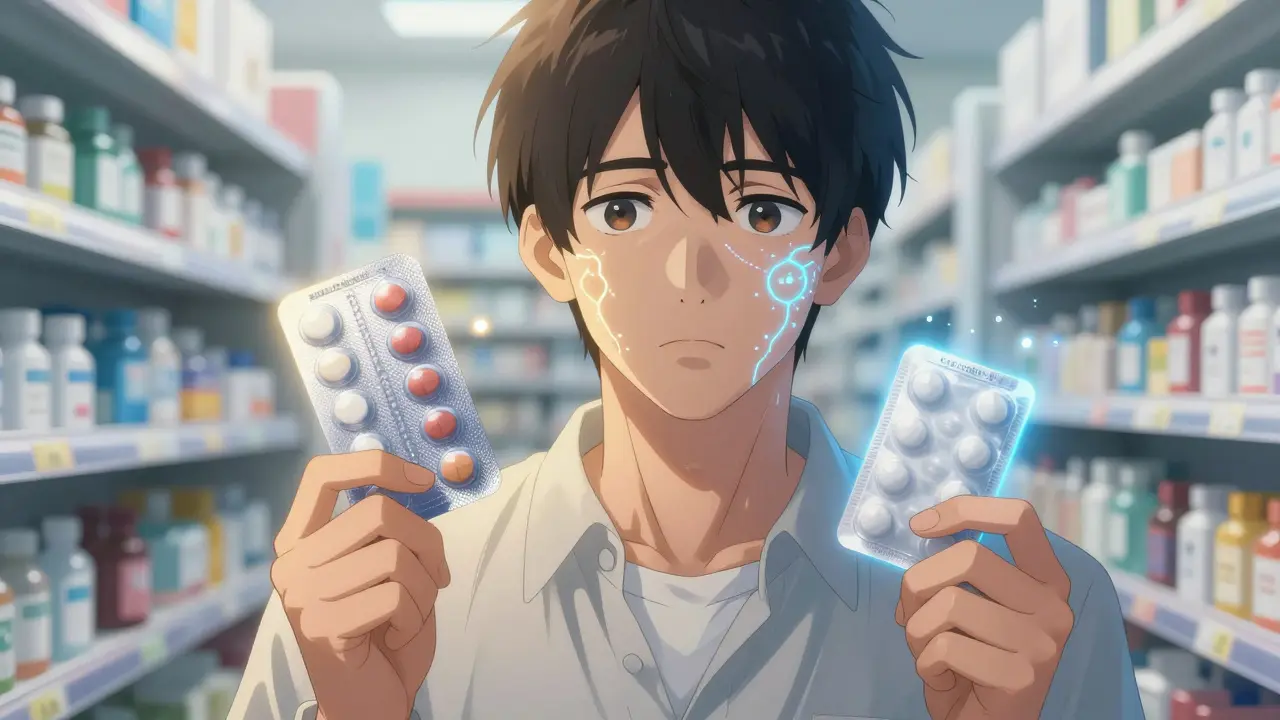
When you pick up a prescription, do you ever wonder if the pill in your hand is really working-or if your mind is doing the work? It’s not just in your head. The placebo effect with generic medications is real, measurable, and affecting millions of people every day. Even though generics contain the exact same active ingredients as brand-name drugs, many patients report feeling less relief-or more side effects-simply because they know it’s not the brand they’re used to.
Why a Generic Feels Less Effective
A 2016 study by researchers at the University of Reading gave 87 students identical placebo pills labeled either as "Nurofen" or "Generic Ibuprofen." The pills had no active ingredient. But the ones labeled "Nurofen" reduced headache pain just as much as real ibuprofen. The "generic" group? Their pain relief was 45% weaker. The pills were the same. The only difference was the label. This isn’t an isolated case. Similar results show up in studies on antidepressants, painkillers, and even blood pressure meds. Patients who believe they’re taking a brand-name drug report better results-even when they’re not. Their brains respond to the expectation of quality. The body doesn’t know the difference between a brand and a generic. But the mind does. And that mind-body connection changes how the drug works.The Brain’s Role in Healing
fMRI scans from the University of Hamburg show something startling: when people believe they’re taking a branded aspirin, areas of the brain linked to expectation-like the dorsolateral prefrontal cortex-light up more than when they think they’re taking a generic. The same thing happens with price. In one experiment, people were given identical pain creams. One group was told it cost $2.50 per dose. The other, $0.10. The expensive cream reduced pain by half as much as the cheap one. But here’s the twist: the people who thought they got the expensive cream actually had stronger pain signals in their spinal cords. Their bodies were reacting more intensely-not because the cream was better, but because they expected it to be. This isn’t just about feeling better. It’s about biology. Expectation triggers real chemical changes in the brain. Dopamine, endorphins, even cortisol levels shift based on what you believe you’re taking. That’s why a placebo labeled as a brand can outperform a real drug in some trials. Your brain isn’t fooling you. It’s healing you.The Dark Side: Nocebo Effects
The flip side of the placebo effect is the nocebo effect-when negative expectations make things worse. In statin trials, up to 26% of people who got a sugar pill quit because they thought they were getting muscle pain. The drug didn’t cause it. Their belief did. One patient told researchers, "I knew statins cause muscle problems, so I paid attention to every ache." Suddenly, a normal twinge became a symptom. A harmless sensation became a reason to stop treatment. This isn’t rare. In one study, patients taking placebo pills for depression reported side effects like nausea, dizziness, and fatigue-despite zero active ingredients. The more they were told about possible side effects, the more they experienced them. Even the color and shape of the pill matter. Blue pills are associated with calmness. Red with stimulation. A generic pill that looks "cheap" or "bland" can trigger subconscious doubts that weaken the treatment.Branding Isn’t Just Marketing-It’s Medicine
Pharmaceutical companies know this. That’s why some generics now come in "premium" packaging: better colors, clearer labels, even logos. Teva’s "Advil Migraine" is still just ibuprofen. But it’s sold like a brand. And it works better-not because it’s stronger, but because people trust it more. In the migraine market, this branded generic captured 17% of sales, even though it costs half as much as the original. But here’s the catch: simply making generics look fancy doesn’t always help. A 2019 study found that patients given enhanced generic packaging didn’t report better results than those with plain packaging. In fact, the plain ones led to slightly better anxiety reduction. Why? Because the fancy packaging made people think, "Wait, why is this generic so fancy? Is something wrong?" The real win isn’t in packaging. It’s in communication.
What Doctors Can Do-And What They Shouldn’t
A 2020 study in JAMA Internal Medicine found that when doctors spent just two extra minutes explaining that generics are required by law to be identical to brand-name drugs, patient adherence jumped by 20%. That’s not magic. That’s clarity. Good scripts work: "This generic has the same active ingredient as the brand. The FDA tests it to make sure it works the same way. Ninety percent of prescriptions filled in the U.S. are generics-and they work just as well." Bad scripts hurt: "This is just a generic." "It’s cheaper because it’s not as good." "The brand worked better for you before, right?" Even saying "this costs less" can trigger nocebo effects. One study showed that mentioning price increased reported side effects by 35%. Doctors aren’t the only ones who need training. Pharmacists, nurses, even pharmacy websites need to avoid language that undermines confidence. The FDA now recommends avoiding phrases like "just a generic" and instead using "FDA-approved equivalent."Why Some Patients Still Don’t Believe
Despite all the evidence, 63% of Americans still think brand-name drugs are superior. Why? Because we’ve been conditioned to believe it. TV ads scream about innovation. Packaging looks sleek. Prices are higher. We assume cost equals quality. And when we feel worse on a generic, we don’t think, "Maybe it’s my expectations." We think, "This one doesn’t work. I need the real thing." It’s worse in mental health. A 2023 Kaiser Family Foundation survey found only 68% of patients on antidepressants would accept a generic. Compare that to 89% for blood pressure meds. Why? Because depression feels personal. If you’re not feeling better, you don’t want to blame your brain. You want to blame the pill. But here’s the data: in clinical trials, 30-40% of antidepressant response comes from the placebo effect. That means for many people, the belief in the drug is doing half the work. If you switch from a brand to a generic and feel worse, it’s not because the drug changed. It’s because your belief did.What Works: Education, Not Packaging
The most promising solution isn’t prettier bottles. It’s expectation priming. Researchers at Oxford tested a simple video shown to patients before they took their generic medication. The 90-second clip explained how the placebo effect works-how belief influences biology. After watching it, patients reported 28% better symptom relief than those who didn’t. No extra pills. No higher cost. Just knowledge. In Bristol, a pilot program at a local NHS clinic started handing out printed one-pagers with facts about generics. Within six months, refill rates for antidepressants rose by 22%. Patients said things like, "I didn’t realize my mind was part of the treatment. Now I get why I felt better last time."
The Real Cost of Perception
This isn’t just about feeling better. It’s about money. When patients stop taking their generic meds because they think they don’t work, it costs the U.S. healthcare system $28 billion a year in extra doctor visits, ER trips, and hospitalizations. That’s more than the entire annual budget of the NHS in Wales. And it’s avoidable. If adherence to generics rose from 76% to 85%, the U.S. could save $15-20 billion a year. That’s enough to cover free prescriptions for 12 million people. The solution isn’t to trick people into thinking generics are better. It’s to help them understand they already are.What You Can Do
If you’re on a generic medication and feel it’s not working:- Don’t assume the drug is faulty. Ask your doctor to check your blood levels. They’re almost always identical to the brand.
- Consider your expectations. Did you hear "it’s just a generic" from someone? That might be the real cause.
- Look up the FDA’s "Generic Drugs: Questions and Answers" page. Read the science. Knowledge reduces fear.
- Try keeping a symptom journal. Note when you feel better or worse. Often, patterns emerge that have nothing to do with the pill.
- Never say "it’s just a generic." Say "this is an FDA-approved equivalent."
- Explain the placebo effect. It’s not a trick-it’s how the brain heals.
- Use the same color, shape, and size for generics as the brand if possible. Familiarity reduces anxiety.
- Share success stories. One patient told me, "I switched to generic and saved $120 a month. I felt the same. I wish I’d done it sooner."
Final Thought
The placebo effect isn’t a weakness. It’s a feature of human biology. We are wired to respond to meaning, trust, and belief. Generics aren’t inferior. They’re just misunderstood. The same chemical in a different wrapper doesn’t change its power. But your mind? It changes everything.Next time you pick up a prescription, ask yourself: Am I taking the pill-or the story I’ve been told about it?
Do generic drugs work as well as brand-name drugs?
Yes. By law, generic drugs must contain the same active ingredient, in the same strength, and work the same way as the brand-name version. The FDA requires them to be absorbed into the body at the same rate and to the same extent. Studies show they are equally effective for conditions like high blood pressure, depression, and infections. The only differences are in inactive ingredients-like color or filler-which don’t affect how the drug works.
Why do some people feel worse on generic medications?
It’s often due to the nocebo effect-negative expectations. If someone believes generics are inferior, their brain may amplify normal sensations like fatigue or mild nausea, interpreting them as side effects. Studies show patients report more side effects when told a pill is "cheap" or "generic," even when it’s identical to a brand. This isn’t in their head-it’s a real biological response triggered by belief.
Can the placebo effect make a generic drug work better?
Yes. If a patient believes a generic is high-quality-because of clear labeling, trusted packaging, or a doctor’s confident explanation-their brain can trigger the same healing pathways as with a brand-name drug. Research shows that patients who are told a generic is "FDA-approved equivalent" report better outcomes than those who aren’t, even though the pills are identical.
Is it safe to switch from a brand-name drug to a generic?
Yes. The FDA approves generics only after rigorous testing to prove they are bioequivalent to the brand. Millions of people switch safely every day. For most medications, including blood pressure pills, antibiotics, and antidepressants, there’s no clinical reason to avoid generics. The only exceptions are drugs with very narrow therapeutic windows, like warfarin or levothyroxine, where small changes in absorption matter more-these require careful monitoring, but even then, generics are often safe with proper oversight.
Why do generics cost so much less if they’re the same?
Brand-name drugs are expensive because the company paid for research, clinical trials, marketing, and patent protection. Once the patent expires, other companies can make the same drug without those costs. Generics don’t need to repeat expensive trials-they just prove they work the same way. That’s why they’re 80-85% cheaper. The savings go to patients, not to profit margins.
Should I avoid generics because of negative stories online?
No. Online stories often reflect individual experiences shaped by belief, not science. A patient who feels worse on a generic may be reacting to the label, not the drug. Clinical trials involving thousands of people show generics are just as effective. If you’re concerned, talk to your doctor or pharmacist. They can explain the science and help you decide based on facts, not fear.
Can packaging or color affect how well a generic works?
Indirectly, yes. Color and design can shape expectations. Blue and white pills are often associated with trust and calm, which can improve outcomes for anxiety meds. But simply making a generic look "premium" doesn’t guarantee better results. What matters more is clear communication from your healthcare provider. A simple explanation about equivalence has a bigger impact than fancy packaging.
Are there any drugs where generics really don’t work as well?
Very few. For most medications, generics are just as effective. The FDA has found no meaningful difference in effectiveness for over 90% of generic drugs. The only exceptions involve drugs where tiny changes in absorption matter-like thyroid medication or blood thinners. Even then, studies show generics work fine when properly monitored. The issue isn’t the generic itself-it’s inconsistent manufacturing or poor patient follow-up.


