
A quiet room. A person slumped in a chair, barely responsive, breathing slow and shallow. To the untrained eye, they might just be sleeping deeply or drunk on alcohol. But if that person has taken too many benzodiazepines - drugs like diazepam, alprazolam, or lorazepam - this silence is dangerous. This is a medical emergency.
Benzodiazepine overdose is not always fatal on its own, but it creates a cascade of risks that can kill you within hours if ignored. The real killer isn't usually the benzo itself; it's what happens when those drugs mix with opioids or alcohol, shutting down your ability to breathe. In 2022, benzodiazepines were involved in over 112,000 exposure cases in the US alone, resulting in more than 100 major outcomes and dozens of deaths. While isolated overdoses have a low mortality rate (around 0.01-0.05%), mixing them with other central nervous system depressants increases the risk of death by 15-fold.
Recognizing the Signs: It’s Not Just Sleepiness
You need to know what to look for before calling for help. Benzodiazepines depress the central nervous system (CNS). When someone takes too much, their brain slows down dangerously. Early signs are subtle: slurred speech, confusion, and poor coordination (ataxia). As the overdose progresses, these symptoms deepen into severe drowsiness, difficulty waking up, and eventually coma.
The critical danger sign is respiratory depression. Watch their chest. Is it rising slowly? Are there long pauses between breaths? If their breathing drops below 10 breaths per minute, or if they stop breathing entirely, time is running out. Unlike opioid overdoses, where pupils often pinpoint to tiny dots, benzodiazepine overdose typically leaves pupils normal-sized or slightly dilated. This distinction matters because it changes how first responders treat the patient.
If you suspect an overdose, do not wait for them to "sleep it off." Call emergency services immediately. Check their airway for obstructions and keep them on their side (recovery position) to prevent choking if they vomit. Never leave them alone.
The ABCDE Approach: Standard Emergency Care
When paramedics arrive or you reach the emergency department, the treatment follows a strict protocol known as the ABCDE approach, standardized by bodies like the Resuscitation Council UK. This isn't optional; it's the lifeline.
- Airway: Can they protect their throat? If their Glasgow Coma Scale (GCS) score is 8 or lower, they cannot. They likely need intubation to keep their airway open.
- Breathing: Oxygen is administered via a non-rebreather mask at 15L/min initially. For patients with COPD who retain carbon dioxide, doctors switch to a Venturi mask to avoid worsening their condition.
- Circulation: Blood pressure and heart rate are monitored continuously. IV fluids may be given if blood pressure drops.
- Disability: Doctors check neurological status using the GCS and test blood glucose immediately to rule out hypoglycemia, which mimics overdose symptoms.
- Exposure: The patient is fully examined for other injuries or signs of trauma.
Supportive care is the cornerstone of treatment. Most people recover simply by having their breathing supported while their body metabolizes the drug. There is no magic pill that instantly reverses the effects safely in every case.
The Flumazenil Dilemma: Why Doctors Rarely Use It
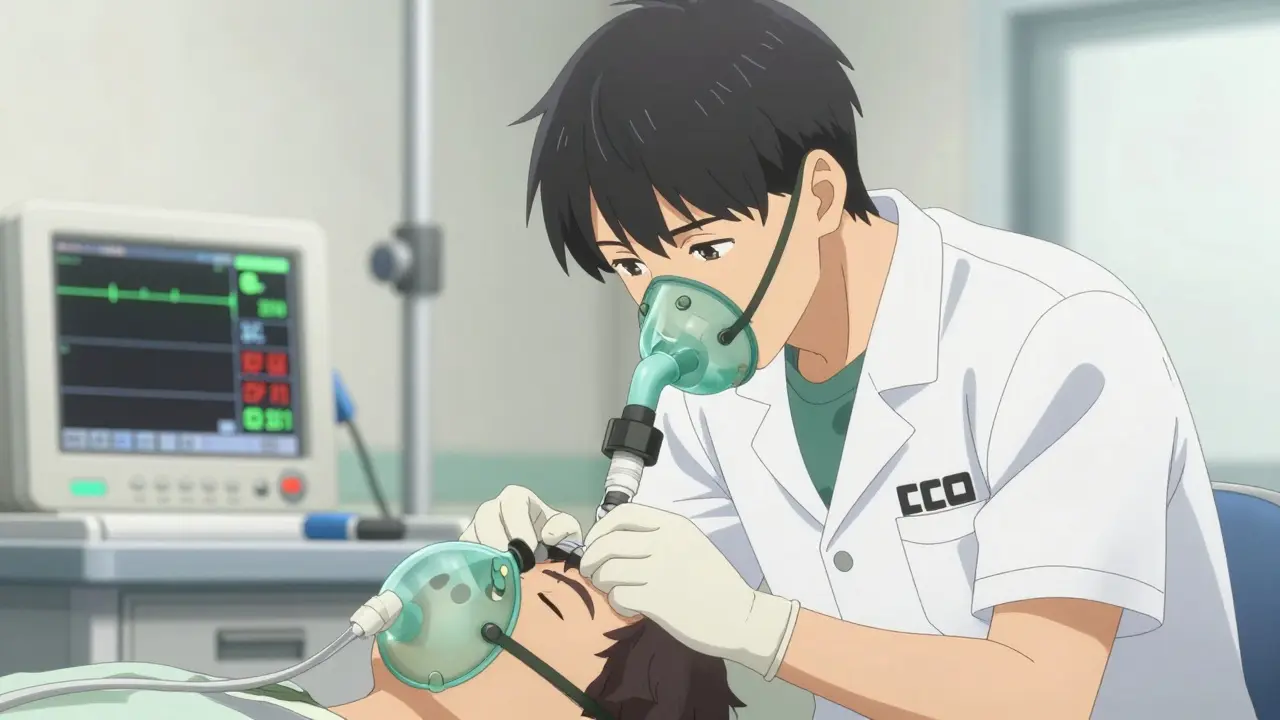
If you’ve heard of flumazenil, you might think it’s the antidote to benzodiazepine overdose. Technically, it is. It blocks the receptors that benzodiazepines bind to. So why don’t emergency rooms use it routinely?
Because it can kill you.
Flumazenil carries a 38% risk of precipitating seizures in patients who are chronically dependent on benzodiazepines. If someone has been taking benzos daily for anxiety or insomnia, suddenly reversing the effect shocks their brain into seizure activity. These seizures can be severe and hard to stop. Additionally, flumazenil has a short half-life of about 41 minutes. Even if it works, the sedation often returns once the drug wears off, requiring repeat dosing.
Experts like Dr. John Howland from NYU School of Medicine reserve flumazenil only for very specific scenarios: pure benzodiazepine overdoses in non-dependent patients with severe respiratory depression that doesn’t respond to standard support. The American College of Medical Toxicology estimates it is appropriate in less than 1% of cases. In 2023, the American Heart Association removed flumazenil from its Advanced Cardiovascular Life Support (ACLS) guidelines. Most emergency departments have stopped stocking it routinely due to these safety concerns.
Mixed Overdoses: The Real Danger Zone
The vast majority of serious benzodiazepine-related deaths involve co-ingestants. According to CDC data, 92% of benzodiazepine fatalities occur when the drug is mixed with opioids or alcohol. This combination hits the brainstem’s respiratory center from multiple angles, causing complete shutdown.
In these cases, doctors may administer naloxone to reverse the opioid component. However, naloxone does nothing for the benzodiazepine. You might see the patient start breathing again, but they remain profoundly sedated and unable to protect their airway. This often leads to prolonged ventilation. One emergency physician reported cases where patients required 12+ hours of mechanical ventilation after naloxone reversed the opioid effect but left the benzo-induced coma intact.
This is why screening for co-ingestants is mandatory. Doctors will run urine toxicology screens, serum ethanol levels, and checks for acetaminophen or aspirin. Missing a hidden opioid ingestion is a common pitfall, occurring in nearly 30% of cases according to BMJ Best Practice guidelines.
Monitoring and Observation: Time Heals
Once stabilized, the patient enters a monitoring phase. How long does this last? It depends on the drug and the person.
| Patient Type | Minimum Observation Time | Key Considerations |
|---|---|---|
| Asymptomatic / Mild Symptoms | 6 Hours | Must remain stable with normal vital signs throughout. |
| Symptomatic (Standard) | 12 Hours | Monitor until CNS depression resolves completely. |
| Elderly / Comorbidities | 24-48 Hours | Slower metabolism extends drug presence; higher fall risk. |
| Alprazolam Overdose | Extended Monitoring | 3.2x more likely to require intubation; deeper CNS depression. |
Doctors monitor respiratory rate, oxygen saturation, and level of consciousness continuously. A key insight from recent clinical reviews is that ataxia (loss of coordination) often lasts longer than sedation. Discharging a patient who is awake but still stumbling is a mistake. They are at high risk for falls and injury. Re-assessment must happen every 15 minutes after any intervention.
New technology is changing this landscape. The FDA approved continuous benzodiazepine blood level monitors for clinical trials in 2023, showing over 94% accuracy in predicting when sedation will resolve. Point-of-care ultrasound (POCUS) is also being used to assess respiratory function faster, reducing intubation delays by an average of 22 minutes.
Activated Charcoal and Detox Myths
There is a lot of misinformation about "detoxing" at home. Let’s be clear: activated charcoal has almost no role in modern benzodiazepine overdose management unless administered within 60 minutes of ingestion. Even then, it only reduces absorption by about 45%. After that window, the drug is already in the bloodstream. Hemodialysis and whole bowel irrigation are ineffective for benzodiazepines and are not recommended.
Do not try to induce vomiting. Do not give coffee or cold showers. These methods do not speed up metabolism and can cause aspiration pneumonia if the patient vomits while unconscious. The only effective treatment is supportive care in a hospital setting.
The Rise of Illicit Benzodiazepines
A growing threat in 2026 is the proliferation of illicitly manufactured benzodiazepines like etizolam and clonazolam. These substances are 3 to 10 times more potent than traditional prescription benzos. They account for nearly 70% of severe overdose cases in parts of the Western US. Because they are not standard in urine drug screens, doctors often miss them, leading to delayed treatment. The American College of Medical Toxicology predicts a 40% increase in related ER visits by 2025 due to these potent analogs.
If you or someone you know is struggling with substance use, remember that harm reduction programs now include benzodiazepine recognition training. Thirty-seven US states have integrated this into naloxone distribution programs. Knowledge saves lives.
Can you die from a benzodiazepine overdose alone?
Yes, but it is rare. Isolated benzodiazepine overdose has a mortality rate of approximately 0.01-0.05%. Death usually occurs due to complications like aspiration pneumonia or prolonged immobilization rather than direct respiratory failure. However, the risk skyrockets when combined with opioids or alcohol.
Is flumazenil safe to use in all benzodiazepine overdoses?
No. Flumazenil is contraindicated in patients with chronic benzodiazepine dependence or mixed overdoses involving pro-convulsant drugs (like tricyclic antidepressants). It carries a significant risk of triggering life-threatening seizures. It is reserved for specific, controlled hospital settings.
How long does it take for benzodiazepines to leave the system after an overdose?
It varies by drug. Short-acting benzos like alprazolam may clear in 12-24 hours, while long-acting ones like diazepam can take several days. Patients are typically monitored for at least 6 hours if asymptomatic, or 12-48 hours if symptomatic, especially if elderly or having liver issues.
What should I do if I find someone unconscious after suspected benzo use?
Call emergency services immediately. Place them in the recovery position (on their side) to keep the airway clear. Monitor their breathing. Do not leave them alone. Do not attempt to make them drink water or walk around. Stay with them until help arrives.
Why are illicit benzodiazepines like clonazolam so dangerous?
Illicit benzodiazepines are often 3-10 times more potent than prescribed versions. Users may not realize the strength, leading to accidental massive overdoses. Furthermore, standard urine drug tests in many hospitals do not detect these new analogs, delaying correct diagnosis and treatment.