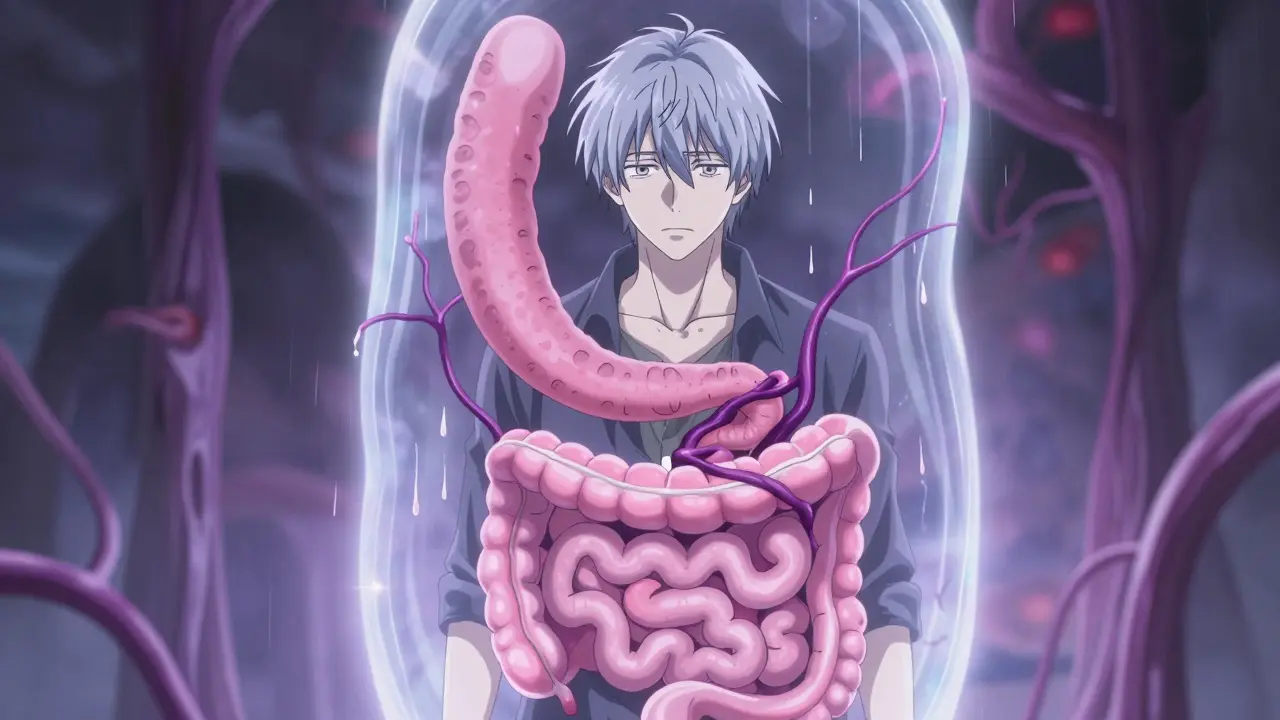
Barrett’s esophagus isn’t a disease you can ignore. It’s a silent change in the lining of your esophagus - the tube that connects your throat to your stomach - triggered by years of acid reflux. Left unchecked, it can turn into cancer. But here’s the good news: if caught early and managed right, the risk of esophageal cancer drops dramatically. This isn’t about fear. It’s about knowing what’s happening inside your body and what you can actually do about it.
What Exactly Is Barrett’s Esophagus?
Barrett’s esophagus happens when the normal tissue lining your lower esophagus - which looks like flat, protective skin - gets replaced by tissue that resembles the lining of your intestine. This change, called metaplasia, is your body’s attempt to protect itself from constant acid exposure. It’s a reaction to long-term GERD, especially if you’ve had heartburn or regurgitation at least once a week for five years or more.
It’s not cancer. But it’s the only known pathway to esophageal adenocarcinoma, a type of cancer that’s become far more common in the last 50 years. The American Cancer Society reports a 600% increase in cases since the 1970s. The scary part? When diagnosed late, only about 20% of people survive five years. But if caught early - before cancer even forms - survival jumps to 80-90%.
Who’s at risk? Men over 50, especially white men, are far more likely to develop it. Obesity, especially belly fat, smoking, and a family history of Barrett’s or esophageal cancer all raise your odds. Interestingly, alcohol doesn’t increase your risk, and some research even suggests that H. pylori stomach bacteria might lower it by reducing stomach acid production.
How Does Dysplasia Turn Barrett’s Into a Cancer Risk?
The real danger isn’t Barrett’s itself - it’s what it can become: dysplasia. That’s the medical term for abnormal cell growth that’s not yet cancer but is heading in that direction.
There are two levels: low-grade dysplasia (LGD) and high-grade dysplasia (HGD). LGD means cells are starting to look strange under the microscope. HGD means they’re very abnormal - almost cancerous. The progression risk isn’t the same for everyone. If you have non-dysplastic Barrett’s, your chance of developing cancer is low - about 0.2% to 0.5% per year. But if you have confirmed LGD? That risk jumps to 5 times higher. And if you have HGD? The chance of turning into cancer within a year can be as high as 40%.
Other factors make it worse. A long segment of Barrett’s (over 3 cm, especially over 10 cm) increases your risk by more than 10 times. Persistent acid reflux, even on medication, keeps the damage going. Smoking, caffeine, and even colonic polyps are linked to faster progression. One study showed that people whose reflux didn’t fully improve on proton pump inhibitors had a 7.3 times higher chance of cancer progression.
Here’s the catch: diagnosing dysplasia isn’t perfect. Community pathologists agree with expert GI pathologists on low-grade dysplasia only about 55% of the time. That’s why many doctors now recommend a second opinion from a specialist if LGD is found.
Ablation: The Gold Standard for Stopping Cancer Before It Starts
If you have confirmed dysplasia - especially HGD - the goal isn’t just to monitor. It’s to remove the abnormal tissue before it turns cancerous. That’s where ablation comes in.
Radiofrequency ablation (RFA) is the most proven method. It uses controlled heat to destroy the abnormal lining. The HALO360 catheter treats the whole circumference of the esophagus; the HALO90 targets specific spots. Studies show RFA clears intestinal metaplasia in 77% of cases and eradicates dysplasia in nearly 88% after one year. By the second year, complete eradication rates climb to over 90%.
Why is RFA the go-to? Because it’s precise, effective, and relatively safe. Strictures (narrowing of the esophagus) happen in about 6% of cases - manageable with simple dilation procedures. There’s no skin sensitivity, no long recovery, and no systemic side effects. It’s now used in 78% of all ablation procedures in the U.S.
Other Ablation Options - What Else Is Out There?
RFA isn’t the only tool. Cryoablation uses freezing instead of heat. The Barrx CryoBalloon sprays nitrous oxide to freeze tissue to -85°C for 20 seconds. It’s newer, but promising. One trial showed 82% dysplasia eradication. It’s especially useful if you’ve had prior strictures - the risk of new strictures is lower than with RFA. But it’s less effective at removing the full metaplastic lining - only 65% complete eradication compared to 91.5% with RFA.
Photodynamic therapy (PDT) uses a light-sensitive drug and laser light to destroy tissue. It works, but it’s outdated. You have to avoid sunlight for 48 hours after treatment. And it causes strictures in 17% of cases - more than double the rate of RFA. Fewer doctors use it now.
Endoscopic mucosal resection (EMR) isn’t ablation - it’s removal. It’s used when there’s a visible lump or nodule in the esophagus. It can remove the entire abnormal patch in one piece for testing. It’s very effective for small lesions (93% success rate) but carries a small risk of bleeding or perforation. It’s often combined with RFA to treat both flat and raised areas.
Cost, Recovery, and Real Patient Experiences
RFA costs around $12,450 per session, including facility and doctor fees. Cryoablation is cheaper - about $9,850. But RFA usually needs fewer repeat sessions. Over five years, the total cost per quality-adjusted life year (QALY) is nearly the same for both.
Recovery is quick. Most people go home the same day. You’ll feel some chest discomfort for a few days, like a bad heartburn. Eating soft foods for a week helps. The real issue? Strictures. About one in three patients needs one or more dilation procedures after ablation. One Reddit user shared: “I had three RFA sessions. Got rid of the Barrett’s. But I needed four dilations. The pain during dilation was worse than the reflux.”
But others report life-changing results. “My chronic cough from reflux vanished after cryoablation,” wrote one patient on a support forum. “I haven’t needed a cough drop in two years.”
The biggest complaint? Not being warned about strictures. A 2023 analysis found 42% of negative reviews mentioned doctors didn’t explain this risk upfront.

Who Should Get Ablation - And Who Shouldn’t?
Guidelines are clear: if you have confirmed HGD, ablation is standard. For LGD, it’s strongly recommended - especially if you’re young, have long-segment Barrett’s, or have other risk factors like smoking or obesity.
But here’s the controversy: many people with non-dysplastic Barrett’s are getting ablation anyway. Studies show 25-30% of these procedures are unnecessary. Why? Because dysplasia is hard to diagnose. If your biopsy says LGD, ask for a second opinion from a GI pathology expert. Don’t rush into treatment based on a single report.
And if you’re over 80, have serious heart or lung disease, or can’t tolerate endoscopy? Surveillance - regular endoscopies every 1-3 years - might be safer than ablation.
What Happens After Ablation?
Ablation isn’t a cure-all. You still need to manage your GERD. High-dose proton pump inhibitors (like esomeprazole 40mg twice daily) are now part of the standard aftercare. One 2023 study showed this cuts recurrence risk by more than half.
You’ll need follow-up endoscopies. Typically, one at 3 months, then again at 6 and 12 months. If everything looks clean, you can go to yearly checks. But if Barrett’s tissue comes back - which happens in about 10-20% of cases - you’ll need another round of ablation.
Advanced endoscopy tools help. Narrow-band imaging and high-definition scopes make it easier to spot early changes. The Seattle protocol - taking four biopsies every 2 cm along the Barrett’s segment - reduces missed dysplasia by over 50%.
The Future: AI, Biomarkers, and Better Access
The field is moving fast. In 2024, new RFA devices like the HALO460 will treat longer segments more effectively. The FDA just approved the Barrx iCAP system with real-time temperature control, making cryoablation even safer.
AI is next. Google Health’s pilot system detected dysplasia with 94% accuracy - better than most human endoscopists. In the next five years, AI could flag suspicious areas during your endoscopy, reducing missed diagnoses.
Biomarkers like TFF3 methylation testing are being studied to predict who’s truly at risk. If validated, they could reduce unnecessary biopsies and ablations by 30%.
But access remains a problem. In rural areas, only 42% of practices offer ablation, compared to 85% in academic hospitals. People in these areas are 2.3 times more likely to die from esophageal cancer. Closing this gap is the next big challenge.
Barrett’s esophagus isn’t a death sentence. It’s a warning sign - one you can act on. With proper surveillance and timely ablation, you can stop cancer before it starts. The tools are here. The data is clear. What matters now is knowing your risk, asking the right questions, and making sure you’re treated by someone who’s trained and experienced.
Can Barrett’s esophagus go away on its own?
Rarely. In some cases, especially with aggressive acid suppression, the abnormal tissue may shrink or become less detectable. But true regression - where the intestinal-type cells fully disappear without treatment - happens in less than 5% of cases. Relying on spontaneous reversal is dangerous. Active management with surveillance or ablation is the only proven way to reduce cancer risk.
Is ablation painful?
The procedure itself is done under sedation, so you won’t feel anything. Afterward, most people experience chest discomfort or a sore throat for a few days - similar to bad heartburn. The real discomfort comes later if you develop a stricture and need dilation. Those procedures can be uncomfortable, but they’re done with sedation too. Most patients say the temporary pain is worth avoiding cancer.
Do I still need to take PPIs after ablation?
Yes. Even after the abnormal tissue is gone, your GERD hasn’t disappeared. Continuing high-dose proton pump inhibitors (like esomeprazole 40mg twice daily) is now standard. It reduces the chance of Barrett’s coming back by more than half. Stopping PPIs after ablation is one of the most common reasons for recurrence.
How often do I need endoscopies after ablation?
After successful ablation, you’ll have your first follow-up endoscopy at 3 months. If everything looks clean, the next is at 6 months, then at 12 months. After that, annual endoscopies are usually enough - unless tissue returns. Your doctor will adjust based on your individual risk and how well the tissue responded.
Can I drink alcohol with Barrett’s esophagus?
Yes, alcohol doesn’t increase your risk of Barrett’s or its progression to cancer, according to the American Cancer Society. But it can worsen GERD symptoms. If alcohol triggers your reflux, it’s best to avoid it - not because it causes cancer, but because it makes your acid reflux worse, which can keep damaging your esophagus.
What’s the difference between LGD and HGD?
Low-grade dysplasia (LGD) means cells show mild abnormalities - they’re not normal, but they’re not close to cancer. High-grade dysplasia (HGD) means the cells are severely abnormal, nearly indistinguishable from cancer cells. HGD has a much higher chance of turning into cancer - up to 40% per year - and is treated immediately. LGD is more uncertain and often requires a second opinion before treatment.
Is Barrett’s esophagus hereditary?
Yes, there’s a strong genetic component. If a close family member has Barrett’s esophagus or esophageal cancer, your risk increases by 23%. This is why doctors recommend earlier screening for people with a family history - even if their reflux symptoms are mild.
Can I avoid ablation if I have LGD?
You can, but it’s not recommended. Surveillance every 6-12 months is an option, but studies show ablation reduces cancer progression by 90% compared to just watching. If you’re under 70, have other risk factors, or want to eliminate the cancer risk entirely, ablation is the better choice. But if you’re older, have other serious health issues, or prefer to avoid procedures, surveillance with expert pathology review is still a valid option.


