
Imagine waking up one day and realizing that the world sounds a bit muffled, as if you're listening to everything through a thick wall. You might find yourself leaning in closer during conversations or wondering why your partner suddenly sounds like they're mumbling. For many adults between 30 and 50, this isn't just aging or a temporary ear infection-it's often otosclerosis is a pathological condition where abnormal bone remodeling occurs in the middle ear, specifically causing the stapes bone to fuse and stop vibrating. While the idea of "bone growth" in your ear sounds scary, this condition is one of the most treatable forms of hearing loss. Whether you're staring at a confusing audiogram or just noticing a change in your hearing, understanding how this works is the first step toward getting your clarity back.
What is actually happening in your ear?
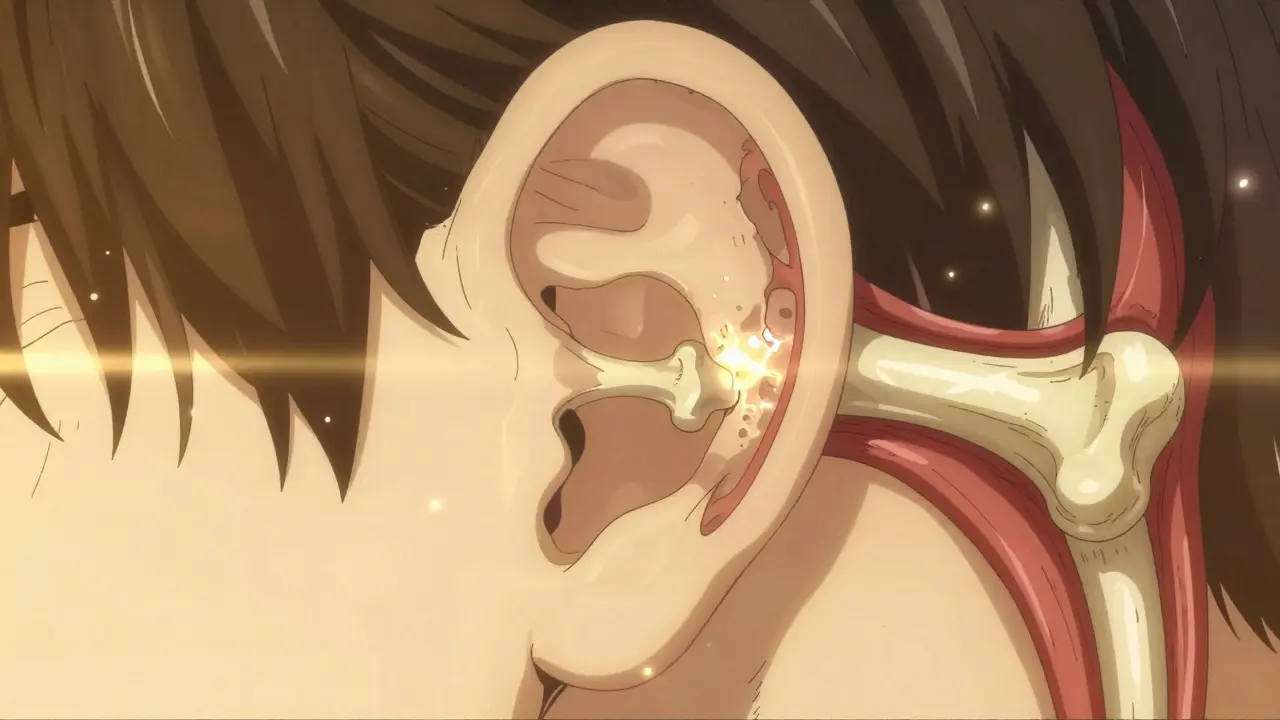
To understand otosclerosis, we have to look at the mechanics of the middle ear. Your ear relies on three tiny bones to move sound from your eardrum to your inner ear. The last and smallest of these is the stapes, a bone measuring only about 3.2mm in length. In a healthy ear, the stapes vibrates freely, pushing sound waves into the cochlea.
With otosclerosis, the normal bone of the stapes is replaced by a spongy, vascular tissue that eventually hardens. This process usually targets the oval window, where the stapes connects to the inner ear. Instead of vibrating, the stapes becomes fused to the surrounding structures. Because the bone can't move, sound waves simply can't get through. This creates what doctors call conductive hearing loss-the inner ear (the nerve) is usually fine, but the "conduction" system is broken.
How to spot the warning signs
Otosclerosis doesn't usually hit you all at once; it's a slow creep. You might notice that you struggle more with low-pitched sounds, which is a classic tell-tale sign. While noise-induced loss usually kills high frequencies first, otosclerosis often makes whispers or deep voices hard to distinguish. This is why many people, especially women (who make up about 70% of cases), initially think their loved ones are just mumbling.
Besides the muffled hearing, you might experience these common symptoms:
- Tinnitus: About 80% of patients report a ringing or buzzing in the ears, which can become disruptive enough to ruin a good night's sleep.
- The "Paracusis Willisoni" Effect: Interestingly, some people find they can actually hear better in noisy environments because they naturally turn up their internal volume, and the background noise doesn't interfere with the low frequencies they are struggling to catch.
- Gradual Decline: Without intervention, hearing can drop by 15-20 dB over five years, making phone calls and group settings increasingly frustrating.
Otosclerosis vs. Other Hearing Issues
It's easy to confuse otosclerosis with other conditions, but the differences are concrete. For instance, it's not like presbycusis (age-related loss), which typically starts after 65. Otosclerosis hits much earlier, often peaking between ages 35 and 45. It also differs from Meniere's disease because you won't have the sudden, violent vertigo attacks or the fluctuating hearing levels that characterize Meniere's.
| Feature | Otosclerosis | Noise-Induced Loss | Presbycusis |
|---|---|---|---|
| Primary Age of Onset | 30-50 years | Any age | 65+ years |
| Frequency Impact | Low-pitched sounds | High-pitched sounds | High-pitched sounds |
| Type of Loss | Conductive/Mixed | Sensorineural | Sensorineural |
| Surgical Fix? | Yes (High success) | No | No |
Getting a Diagnosis: What to expect
If you suspect something is wrong, you'll likely visit an audiologist or an ENT (ear, nose, and throat specialist). They don't just ask "can you hear this?" They use specific tools to pinpoint the blockage. The gold standard is pure-tone audiometry. Doctors look for an "air-bone gap" of at least 15 dB. This means your bone conduction (sound traveling through the skull) is much better than your air conduction (sound traveling through the ear canal), proving the problem is mechanical, not neural.
In some cases, a temporal bone CT scan is used to see the physical bone growth. Early stages can show tiny radiolucent foci (small gaps or spots) measuring only 0.5 to 2.0mm. While the exact cause is still being studied, genetics play a huge role. Research has identified 15 genetic loci linked to the condition, with the RELN gene on chromosome 7 being a primary suspect.
Treatment options: From aids to surgery
The good news is that otosclerosis is one of the most surgically correctable forms of hearing loss. You generally have two main paths depending on the severity of your loss and your personal comfort with surgery.
Hearing Amplification
About 65% of people start with hearing aids. This is a non-invasive way to boost the sound and bypass the stapes blockage. It's a great option for those with mild loss or those who aren't candidates for surgery. However, aids don't stop the bone growth; they just manage the symptoms.
Surgical Intervention
When hearing loss reaches 30-40 dB, surgery becomes a serious conversation. The most common procedure is a stapedectomy or stapedotomy. Essentially, the surgeon removes the fused stapes bone and replaces it with a tiny prosthetic. This restores the vibration needed to send sound into the inner ear.
Modern advancements have made this even more effective. For example, the newly approved StapesSound™ prosthesis uses a titanium-nitride coating to prevent the body from creating adhesions (scar tissue) around the implant, boasting a 94% success rate. For most, surgery can close the air-bone gap to within 10 dB in over 90% of cases.

The Risks and Realities of Surgery
No surgery is without risk, and it's important to be honest about them. While the success rate is high, there is a small but devastating risk (about 1%) of experiencing profound sensorineural hearing loss if the inner ear is damaged during the procedure. Furthermore, if the first surgery isn't done perfectly, a revision surgery might be needed, and those have lower success rates (around 75%) compared to the first attempt.
For those not ready for surgery, some research into sodium fluoride suggests it can slow down the progression of the bone growth, reducing deterioration by about 37% over two years. It's not a cure, but it can buy you time.
Can otosclerosis cause total deafness?
It is very rare for otosclerosis to lead to total deafness. While it can cause significant hearing loss, the nerve function usually remains intact. In about 10-15% of cases, it may affect the cochlea (inner ear), causing a mixed hearing loss, but complete deafness is not the typical outcome.
Is otosclerosis hereditary?
Yes, there is a strong genetic component. About 60% of patients report a family history of the condition. Scientists have linked it to specific genetic markers, such as the RELN gene, though not everyone with the gene will develop the disorder.
How long does recovery take after a stapedectomy?
Initial healing takes a few weeks, but patients are typically advised to avoid heavy lifting, straining, or flying for several weeks to ensure the prosthesis stays in place. Most patients notice a significant improvement in hearing almost immediately after the packing is removed from the ear.
What is the success rate of stapes surgery?
The success rate is remarkably high, with about 90-95% of primary procedures resulting in significant hearing improvement. Many patients achieve functional hearing (better than 30 dB) post-operation.
Can I avoid surgery with hearing aids?
Yes, many people manage otosclerosis exclusively with hearing aids. This is often the preferred route for those who are older, have other health complications, or simply prefer not to have surgery. However, hearing aids amplify sound rather than fixing the mechanical blockage.
Next Steps for Managing Your Hearing
If you're noticing the signs, don't just "wait and see." Because otosclerosis is progressive, early diagnosis makes a huge difference. Start by scheduling a pure-tone audiometry test with a licensed audiologist. If you have mild symptoms, a 3-6 month monitoring period with annual audiograms is usually enough to track the progression.
For those already diagnosed, the decision between a hearing aid and surgery often comes down to your lifestyle. If your job requires high-precision hearing-like a teacher who needs to hear students whispering in the back of a room-surgery often provides the most "natural" restoration. If you're less concerned about the physical cause and just want a volume boost, modern hearing aids are a fantastic, low-risk starting point.


