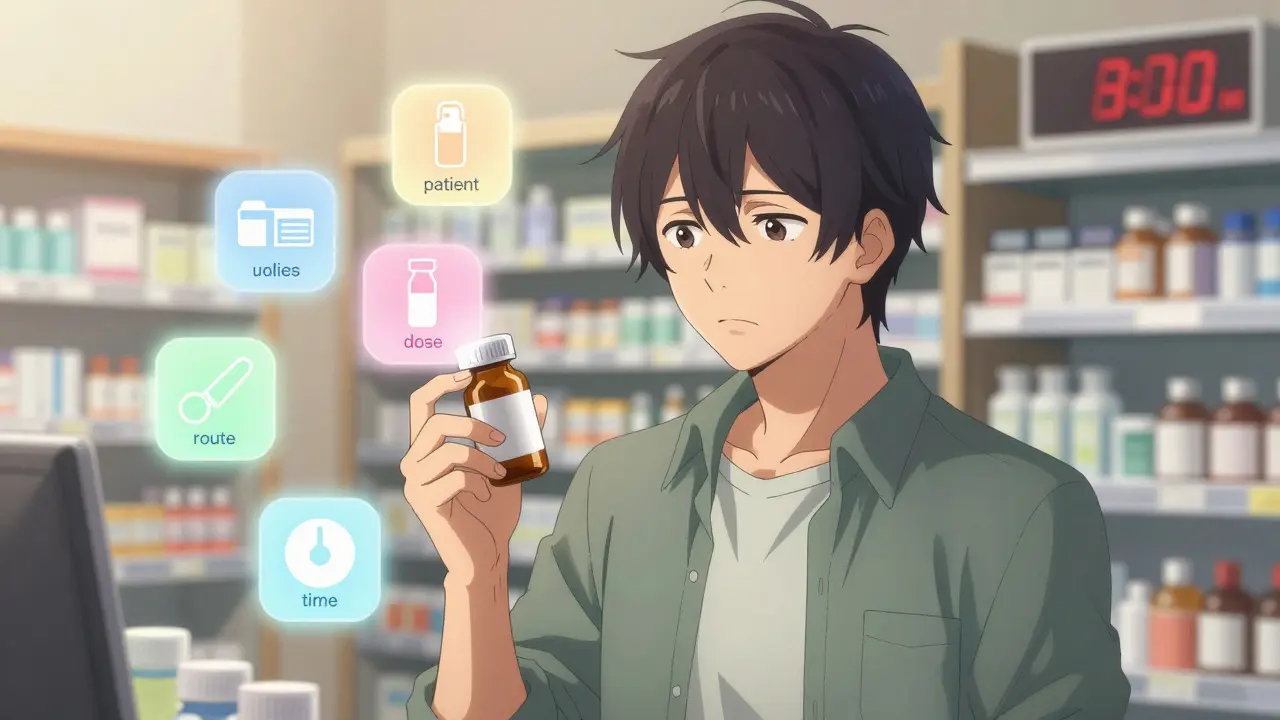
Starting a new medication can feel overwhelming. You’ve got a prescription in hand, maybe a handful of pills, and a doctor’s instruction that sounds like a foreign language. What if you take it wrong? What if it reacts with something else? What if you forget when to take it-or worse, take too much? You’re not alone. Nearly 42% of first-time medication users struggle with dosing schedules, and 37% say they can’t understand the labels. But here’s the good news: with a few simple steps, you can avoid the most common mistakes and stay safe.
Know the Six Rights of Medication Safety
Every time you take a pill, inject a shot, or apply a cream, ask yourself these six questions. They’re called the Six Rights, and they’re the foundation of safe medication use. Hospitals use them. Pharmacists rely on them. You should too.- Right patient: Make sure the name on the bottle matches yours. Double-check your date of birth if you’re picking it up at the pharmacy.
- Right medication: Compare the pill to your prescription. If it looks different than last time, ask why. Generic versions can change shape or color-but the active ingredient should be the same.
- Right indication: Why are you taking this? Is it for blood pressure? Pain? Infection? If you’re not sure, call your doctor or pharmacist. Taking the wrong medicine for the wrong reason can be dangerous.
- Right dose: Never guess. Don’t use kitchen spoons. Use the measuring cup, syringe, or dosing cap that came with the medicine. A teaspoon from your drawer can be 25-50% off from a proper dose.
- Right route: Is it meant to be swallowed, placed under the tongue, injected, or applied to the skin? Taking a patch orally or swallowing a liquid meant for your eye can cause serious harm.
- Right time: Some meds need food. Some need an empty stomach. Some work better in the morning. Others at night. Follow the schedule exactly-even if you feel fine.
These aren’t just rules. They’re your personal safety checklist.
Keep a Complete Medication List
Most people don’t realize how many things they’re taking. Prescription drugs. Over-the-counter pain relievers. Vitamins. Herbal supplements. Even gummies labeled “immune support.” Each one can interact with another.The CDC recommends keeping a full, up-to-date list of everything you take. That includes:
- Brand and generic names
- Dosage (e.g., 10 mg, 500 mg)
- How often you take it (e.g., once daily, every 6 hours)
- Why you take it (e.g., “for high cholesterol,” “for joint pain”)
- When you started
Keep this list on your phone and in your wallet. Bring it to every doctor’s visit-even if you think nothing changed. A 2022 study found that patients who kept a full list had 27% fewer medication errors.
Pro tip: Use a free app like Medisafe or MyMeds. They let you scan barcodes, set reminders, and even alert you if a new drug might clash with what you’re already taking.
Never Take Someone Else’s Medicine
It’s tempting. Your friend says, “This helped my headache,” or your mom says, “I used this for my back pain.” But here’s the truth: what works for one person can hurt another.The FDA says sharing medications causes 8% of emergency room visits due to adverse drug events. Why? Because:
- Drug allergies vary. You might be allergic to something they tolerate.
- Dosage is personal. A pill that’s safe for a 200-pound man could overdose a 120-pound woman.
- Interactions happen. You might be on a blood thinner, and that “simple” painkiller could cause internal bleeding.
Even if it’s “just one pill,” don’t do it. If you need help, ask your pharmacist. They’ll tell you what’s safe-and what’s not.
Store Medications the Right Way
Medications aren’t like canned food. They don’t last forever-and they don’t all like the same conditions.Insulin? Must be refrigerated until opened. After that, it can stay at room temperature for a month. But if you leave it in a hot car or a sunny bathroom, it breaks down. You won’t get the full dose.
Most pills? Keep them in a cool, dry place. Not the bathroom. Humidity turns tablets into mush. Not the dashboard of your car. Heat makes them lose strength.
Check the label. It will say: “Store below 86°F (30°C).” If it doesn’t, ask your pharmacist. Some meds need to be kept in the fridge. Others must be kept away from light. And never store pills in pill organizers if they’re sensitive to moisture-keep them in their original bottles.
Also: throw out expired meds. The FDA says 18% of medication errors come from using expired drugs-especially antibiotics and liquid cough syrups. They don’t just stop working. They can turn toxic.
Read Labels Like a Pro
You think you read the label. But do you really? A 2023 FDA report found that 15% of errors happen because people misread labels in dim light.Here’s how to read them properly:
- Turn on the lights. Use a flashlight if needed.
- Look for the active ingredient. That’s the medicine itself. Other names on the label are brand names or additives.
- Check the dosage instructions. “Take one tablet by mouth” doesn’t mean “take one every hour.”
- Watch for warnings: “May cause drowsiness,” “Avoid alcohol,” “Do not operate machinery.”
- Check the expiration date. If it’s faded or missing, don’t use it.
Generic drugs are just as safe as brand names-but they often look different. That’s normal. If you’re confused, ask your pharmacist: “Is this the same as my last prescription?”
Ask Questions-No Matter How Small They Seem
Pharmacists are trained to help you. But they can’t read your mind.When you get a new prescription, ask these three questions:
- What should I do if I miss a dose? Only 22% of patients ask this. But it’s critical. Some meds you skip. Others you take right away. Others you never double up. Know before you need to.
- How should I store this? Forty percent of medications have specific storage needs. Don’t assume.
- What side effects should I watch for? Only 65% of pharmacy consultations cover this. But knowing what’s normal (like mild nausea) versus dangerous (like swelling, chest pain, trouble breathing) can save your life.
A 2022 study found that patients who asked three or more questions had 34% fewer adverse events in their first month. You’re not being difficult. You’re being smart.
Watch for Changes-Yours and the Medicine’s
Your body can change. So can your meds.If you start feeling dizzy, nauseous, itchy, or unusually tired after starting a new drug, don’t ignore it. Write down what happened, when, and how bad it was. Then call your doctor or pharmacist.
Also, pay attention to the pill itself. If it’s a different color, shape, or size than last time, don’t just take it. Call the pharmacy. Maybe it’s a generic. Or maybe it’s a mistake. Either way, verify.
And if you’re switching pharmacies or hospitals, ask for a “medication reconciliation.” That’s when someone compares all your meds to make sure nothing got lost, added, or changed. About 22% of errors happen during these transitions.

Use Tools to Stay on Track
Memory fails. Life gets busy. That’s why tools exist.- Set phone alarms. Label them clearly: “AM: Blood pressure pill,” “PM: Pain reliever.”
- Use a pill organizer-but only if the meds are stable. Don’t use it for insulin or liquids.
- Try a medication app. Medisafe and MyMeds let you scan barcodes, get reminders, and even notify a family member if you miss a dose.
- Keep a printed chart. Write down: time, dose, what you took, how you felt. It helps your doctor spot patterns.
One study found that first-time users who used these tools improved their adherence by 28% in just 30 days.
It Takes Time-Be Patient With Yourself
Learning to manage meds isn’t something you master in a day. The University of Michigan found it takes most people 2-3 weeks to build a routine. That’s normal.Don’t beat yourself up if you forget once. Don’t panic if you misread a label. Just stop, check your list, call your pharmacist, and move on.
The goal isn’t perfection. It’s awareness. Every time you pause before taking a pill and ask yourself the Six Rights, you’re reducing your risk. And that’s what safety is all about.
When in Doubt, Call Your Pharmacist
Your pharmacist isn’t just the person who hands you the bottle. They’re your medication expert. They know interactions, storage, side effects, and alternatives. And they’re paid to answer your questions.Don’t wait until something goes wrong. Call them now. Say: “I just started this medicine. Can you walk me through how to take it safely?”
You’ll be surprised how many people don’t do this. And you’ll be even more surprised how helpful they are.