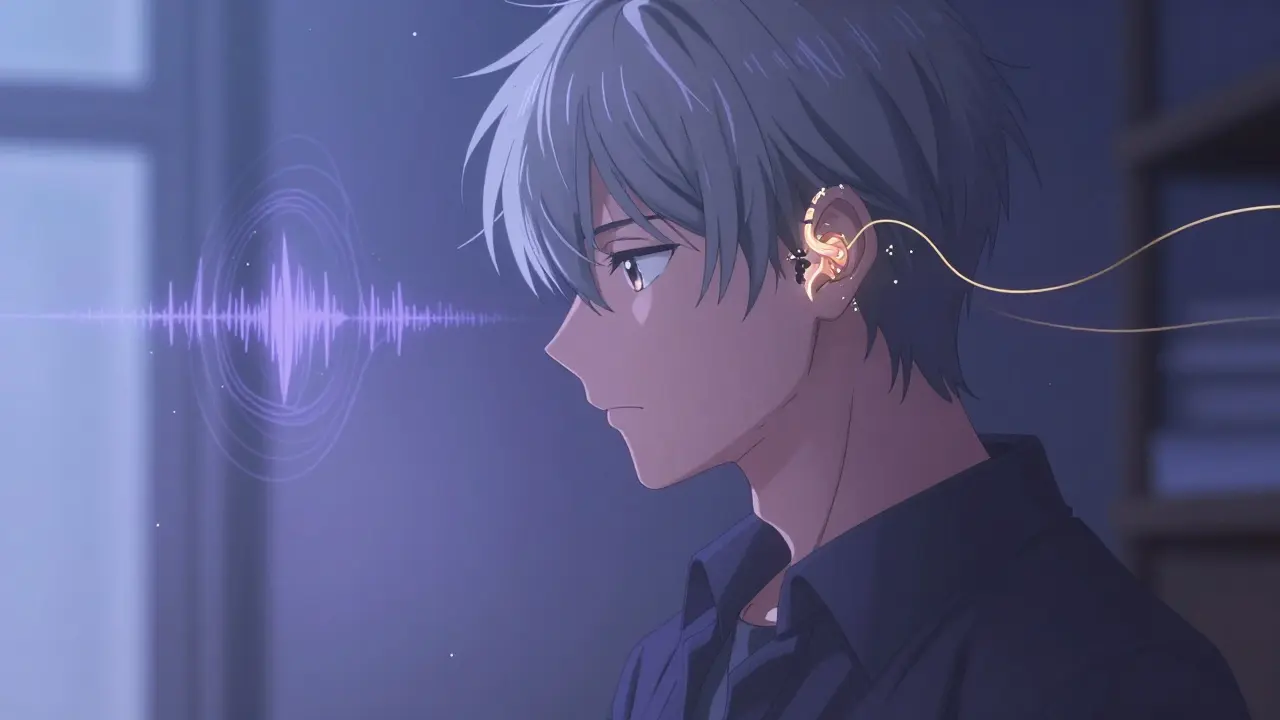
When you can’t hear the doorbell, struggle to follow conversations in a crowded room, or hear a constant ringing in your ears, it’s not just annoying - it might be sensorineural hearing loss. This isn’t a simple case of earwax blocking sound. It’s damage deep inside your inner ear, where tiny hair cells that turn sound into brain signals are destroyed. And once they’re gone, they don’t come back. That’s why this type of hearing loss is almost always permanent.
How Your Inner Ear Turns Sound Into Signals
Your inner ear contains the cochlea, a snail-shaped structure filled with fluid and lined with thousands of microscopic hair cells. These aren’t like the hair on your head. These are specialized sensory cells called stereocilia. When sound waves enter your ear, they vibrate the fluid in the cochlea. Those vibrations bend the hair cells, which then trigger electrical signals that travel up the auditory nerve to your brain. That’s how you hear a voice, music, or even a whisper. There are two main types of these hair cells: inner hair cells and outer hair cells. Inner hair cells do the heavy lifting - they send most of the sound information to your brain. Outer hair cells act like amplifiers. They adjust the sensitivity of your hearing, making soft sounds clearer and helping you focus in noisy places. Damage usually starts with the outer hair cells. That’s why early signs of hearing loss often show up as trouble hearing in background noise, not total silence.What Actually Damages These Hair Cells?
The most common cause of sensorineural hearing loss is age. Around 25% of Americans between 65 and 74 have it. By age 75, that number jumps to 50%. This is called presbycusis. It’s not just about getting older - it’s about decades of exposure to everyday sounds. Even normal conversations, kitchen appliances, and traffic add up. The hair cells slowly wear out. Loud noise is another major culprit. Exposure to sounds above 85 decibels for more than eight hours can cause permanent damage. That’s the level of heavy city traffic or a lawnmower. Concerts, power tools, and headphones turned up too high can all contribute. One loud explosion or prolonged exposure - like working in construction without protection - can wipe out hundreds of hair cells at once. Other causes include genetic factors, certain medications (like some antibiotics or chemotherapy drugs), infections like meningitis or measles, and head trauma. Rarely, a tumor on the auditory nerve (acoustic neuroma) can cause it too. In about 10% of cases, it happens suddenly - known as sudden sensorineural hearing loss (SSHL). That’s when hearing drops over a few hours or days. It’s rare, affecting 5 to 20 people per 100,000 each year, but it’s a medical emergency.Why Most Cases Can’t Be Cured
Unlike a blocked ear canal or a ruptured eardrum, you can’t fix damaged hair cells with medicine or surgery. These cells don’t regenerate in humans. Once they’re gone, they’re gone. That’s why hearing aids and cochlear implants aren’t cures - they’re workarounds. There’s one exception: sudden sensorineural hearing loss. If caught within 48 to 72 hours, high-dose steroids (oral or injected into the ear) can help about one-third to two-thirds of patients recover some hearing. But if you wait a week, the chances drop sharply. After two weeks, recovery is unlikely. That’s why anyone who loses hearing suddenly needs to see a specialist immediately. For the rest - the 90% of cases that develop slowly - there’s no way to restore the hair cells. No pill, no injection, no laser. Research is ongoing. Stanford and other labs are testing stem cell therapies to regrow hair cells in animals. But even the most optimistic experts say clinical use is still 5 to 10 years away.
How It Feels to Live With It
People with sensorineural hearing loss don’t just hear less - they hear differently. Many report recruitment: soft sounds are hard to hear, but loud sounds suddenly feel painfully intense. A whisper might be inaudible, but a dog barking feels like a shout. Speech becomes a puzzle. You might hear someone talking but can’t make out the words - especially if more than one person is speaking or there’s background noise. That’s because sensorineural hearing loss often hits the high-frequency sounds first: consonants like s, t, k, f, and th. So “I’d like to go to the park” sounds like “I’d lie to go to the pa-” Tinnitus - that ringing, buzzing, or hissing in the ears - affects about 80% of people with this type of hearing loss. It’s not just a side effect. It can be the most disruptive part of daily life, making sleep, focus, and calm impossible.What Works: Hearing Aids and Cochlear Implants
Hearing aids are the first line of defense. Modern digital devices don’t just make everything louder. They’re programmed using your audiogram - a detailed hearing test - to boost only the frequencies you’ve lost. For age-related loss, that’s usually between 2,000 and 8,000 Hz. Some devices now use AI to reduce background noise, identify speech, and even adjust settings automatically as you move from a quiet room to a busy street. But hearing aids have limits. They improve speech understanding by only 30% to 50% in noisy environments. Many users still struggle at family dinners, restaurants, or work meetings. The average cost? $2,500 to $7,000 per pair. Insurance rarely covers it fully, and that’s a major barrier. For severe-to-profound hearing loss - where pure-tone averages exceed 90 dB - hearing aids aren’t enough. That’s where cochlear implants come in. These devices bypass the damaged hair cells entirely. A small surgical implant sends electrical pulses directly to the auditory nerve. About 82% of recipients achieve open-set speech recognition - meaning they can understand speech without lip-reading. But it’s not magic. The surgery takes a few hours. Activation happens 3 to 4 weeks later. Then comes months of therapy to retrain your brain to interpret these new electrical signals. Some users say everyday sounds - a running faucet, a door closing - feel overwhelming at first. It takes time.