
NICU Medication Safety Tool
Medication Safety Assessment Tool
Select a common NICU medication to learn about its evidence-based safety profile in preterm infants.
Preterm infants are not small adults. They’re not even small babies.
They’re a unique biological state - organs still forming, liver enzymes barely active, kidneys that filter slowly, and brains that are hyper-sensitive to even small changes in drug levels. Every medication given in the NICU carries a risk that’s not just different from older children - it’s often unknown. And yet, 100% of infants born before 28 weeks get at least one drug during their stay. Many get opioids, sedatives, antibiotics, or acid reducers - drugs that weren’t designed for them, tested on them, or labeled for them.
Why do preterm infants need so many drugs?
Because their bodies can’t do what full-term babies can. They stop breathing unexpectedly - that’s apnea of prematurity. Their hearts stay open when they shouldn’t - patent ductus arteriosus. They get infections easily. Their guts can’t handle milk. So doctors give them caffeine to stimulate breathing, indomethacin to close the duct, antibiotics to fight sepsis, and proton pump inhibitors to quiet reflux.
But here’s the problem: most of these drugs weren’t tested in babies born at 24 weeks. Only 35% of medications used in NICUs have FDA approval for infants. Nearly all respiratory and gastrointestinal drugs are used off-label. That means dosing is based on guesswork - often weight-based, but without knowing how the baby’s immature organs will handle it.
Medications that save lives - and harm them
Caffeine citrate is one of the few drugs proven to help preterm infants. It reduces apnea, lowers the chance of cerebral palsy, and helps babies breathe better. But it’s not harmless. Almost 1 in 5 infants on standard doses develop a racing heart. Nearly 1 in 14 can’t feed well because of jitteriness or stomach upset. Dose adjustments aren’t optional - they’re routine.
Opioids like morphine and fentanyl are used for pain during procedures, ventilation, or after surgery. But they’re also linked to long-term brain changes. Studies show that babies exposed to opioids and benzodiazepines in the NICU have higher rates of attention problems, learning delays, and behavioral issues by age 5. The American Academy of Pediatrics now says: don’t use them routinely. Use them only when pain is confirmed, and wean them fast.
Antibiotics are given to almost half of all preterm infants, often for suspected - not confirmed - infections. But they don’t just kill bad bacteria. They wipe out the good ones too. Research shows that preterm babies exposed to antibiotics have 47% more harmful bacteria in their guts, 32% fewer beneficial species like Bifidobacterium, and nearly three times more antibiotic-resistant genes. These changes don’t clear up after discharge. They stick around for years, increasing the risk of asthma, allergies, and recurrent infections.
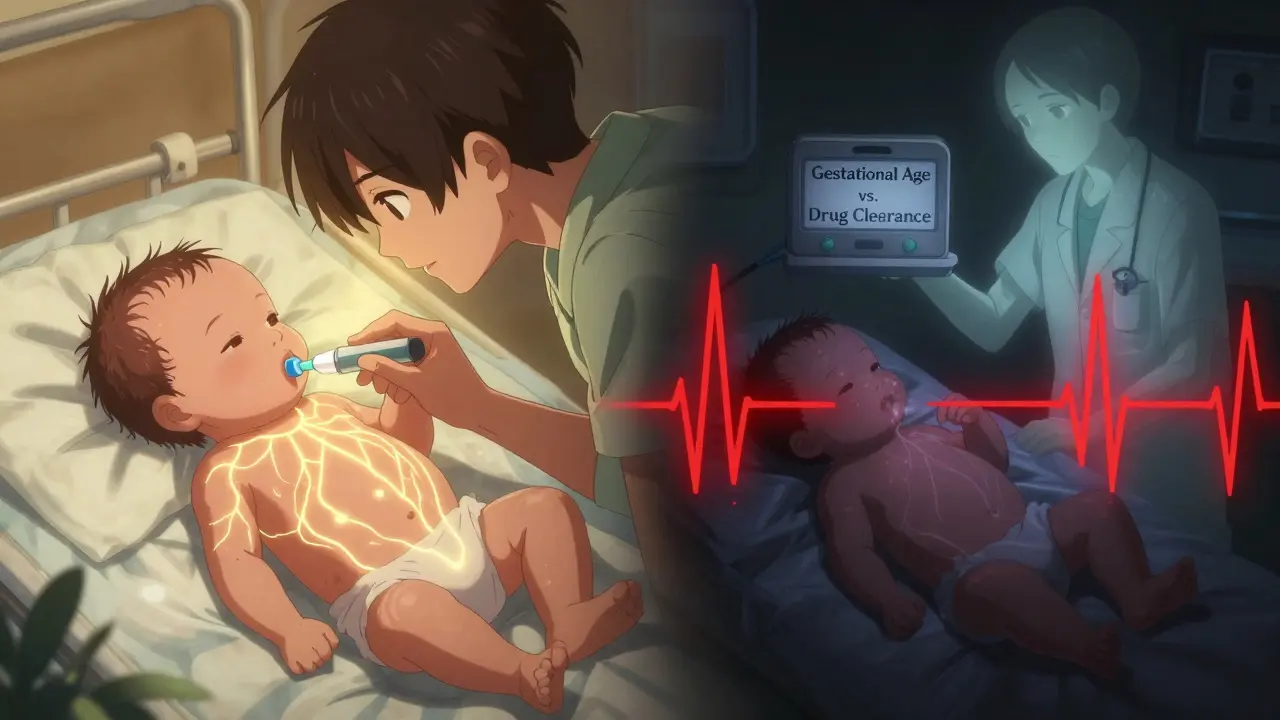
The hidden danger: anti-reflux meds
One of the most common - and most dangerous - mistakes in the NICU is giving acid-suppressing drugs like omeprazole or lansoprazole to babies with reflux. Parents and nurses see spit-up and assume it’s heartburn. But in preterm infants, reflux is usually a mechanical issue - their esophagus is short, their sphincter is weak. It’s not caused by too much acid.
And yet, 41% of NICU graduates get these drugs. Why? Because it’s easy. But the risks are real. These medications increase the chance of necrotizing enterocolitis (NEC) by 1.67 times. They raise the risk of late-onset sepsis by nearly 2 times. And they make bones weaker - 2.3 times more fractures in preterm infants on acid blockers.
The 2022 Cochrane review found zero benefit for these drugs in preterm infants. The AAP updated its guidelines in January 2024 to say: stop using them routinely. If a baby spits up, don’t reach for the PPI. Try positioning, smaller feeds, or thickened milk first.
How dosing goes wrong - and how to fix it
Most NICU errors aren’t about giving the wrong drug. They’re about giving the wrong amount. A 0.1 mL error in a 600-gram infant is a massive overdose. Nurses report that nearly 7 out of 10 have made a dosing mistake in the past month. About a quarter of those led to actual harm - low blood pressure, seizures, or breathing pauses.
Why? Because dosing isn’t just based on weight. It’s based on gestational age and postnatal age. A drug cleared by the liver in a 34-week baby might stay in a 28-week baby’s system for days. Cytochrome P450 enzymes - the body’s main drug-processing system - are only 30% mature at 32 weeks. They don’t reach adult levels until the baby is a year old.
Some NICUs are using software like DoseMeRx to model drug clearance based on age, weight, and organ function. Hospitals using it saw a 58.7% drop in dosing errors for babies under 28 weeks. But not every unit has access. Training matters too. Pharmacists who specialize in neonates need 18 to 24 months of extra training just to feel confident.
The gut microbiome: a silent casualty
Every time a preterm infant gets antibiotics, their gut microbiome is reshaped - and not for the better. The bacteria that help digest milk, train the immune system, and protect against inflammation are wiped out. In their place: resistant strains of Enterobacteriaceae, Klebsiella, and other pathogens.
Dr. Gautam Dantas from Washington University says: “The microbes that survive antibiotics aren’t the ones we want. The makeup of your gut is pretty much set by age 3.” That means a course of antibiotics at 2 weeks old can affect a child’s health for life - increasing risks of asthma, obesity, and autoimmune disorders.
Researchers are now testing “microbiome-sparing” antibiotics in Phase II trials. These drugs target only the bad bacteria, leaving the good ones alone. If they work, they could change how we treat infections in preterm infants - without sacrificing safety.
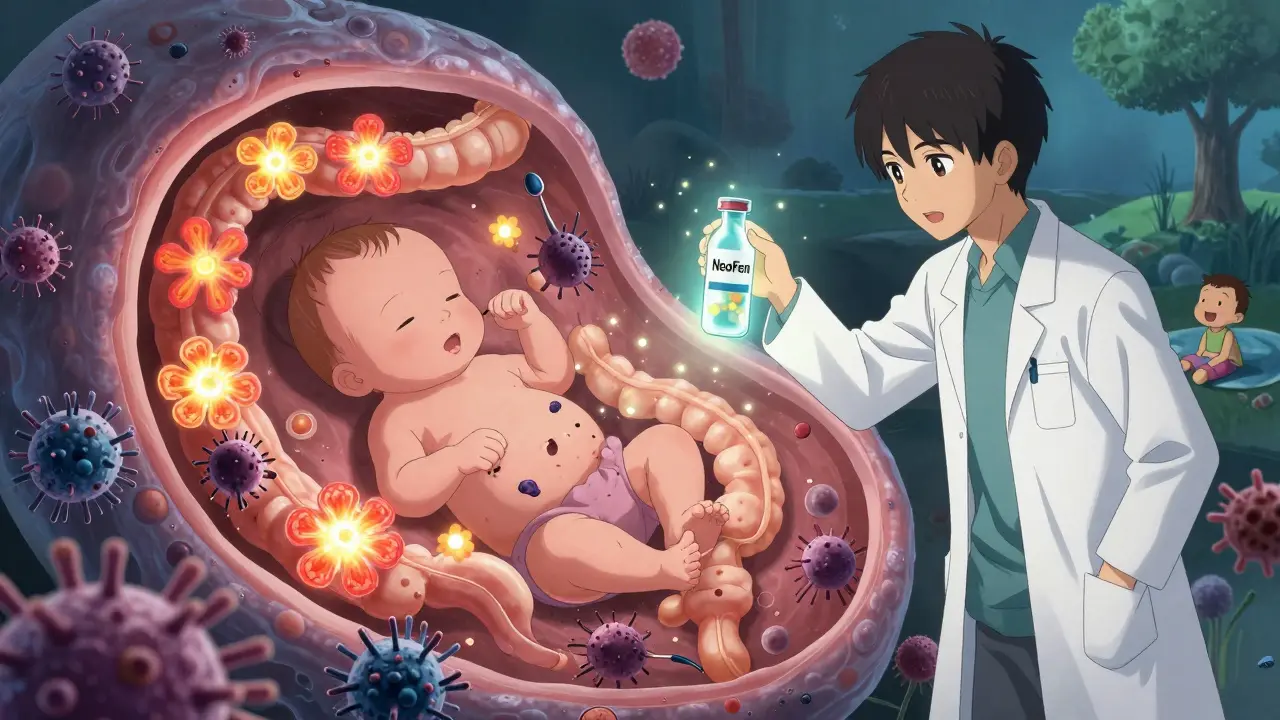
What’s changing - and what’s coming
There’s progress. The FDA’s Best Pharmaceuticals for Children Act has led to 15 new pediatric labels since 2002. The PREEMIE Reauthorization Act of 2018 pushed the NIH to create a dedicated neonatal pharmacology research core. And in 2023, the Eunice Kennedy Shriver Institute launched the Neonatal Precision Medicine Initiative - aiming to build exact pharmacokinetic models for 25 high-risk drugs by 2026.
One of the most exciting developments is NeoFen - the first fentanyl formulation designed specifically for preterm infants. It’s in FDA Fast Track review and could be approved by mid-2025. It’s not just a new version of an old drug. It’s a new system - with precise dosing, stable delivery, and fewer side effects.
But the biggest change isn’t a drug. It’s a mindset. We’re moving from “give something to make them comfortable” to “give the least amount, for the shortest time, with the most monitoring.” We’re learning that comfort isn’t just about pain - it’s about protecting the brain, the gut, and the future.
What parents should ask
If your baby is in the NICU, you have the right to ask:
- Is this medication proven to help preterm infants?
- Is there a non-drug option we can try first?
- What are the risks if we give this? What are the risks if we don’t?
- Are we monitoring for side effects - and how often?
- When will we stop this, and how?
Many parents feel powerless. But asking these questions can lead to better decisions. One mother on Reddit shared: “My son got 28 days of antibiotics for a possible infection that never showed up. Now at age 2, he’s had five ear infections and two rounds of antibiotics.” That’s not normal. That’s the cost of overuse.
Final thought: Less is often more
Preterm infants don’t need more drugs. They need smarter ones. They need fewer drugs, given with more precision, stopped sooner, and replaced with non-pharmacological care when possible. The goal isn’t just survival. It’s healthy development - a brain that learns, a gut that digests, a body that grows without the weight of medication side effects.
The science is clear. The tools are emerging. The question now is: will we use them?


