Every year, thousands of people panic when they see a viral post claiming their medication has been recalled. A Facebook post says all metformin is dangerous. A TikTok video warns that your blood pressure pill is contaminated. Within hours, clinics are flooded with calls, pharmacies run out of stock, and patients stop taking life-saving drugs-only to later find out the recall never happened. Drug recall verification isn’t just a technical step; it’s a critical safeguard against misinformation that can cost lives. The good news? You don’t need to be a pharmacist to check if a recall is real. You just need to know where to look and what to look for.
Why Fake Recall Alerts Are Dangerous
Fake drug recall alerts aren’t just annoying-they’re deadly. Between 2020 and 2024, the Federal Trade Commission recorded 1,247 cases of consumer harm caused by fraudulent recall scams. These scams often target older adults, people with chronic conditions, or those who rely on multiple medications. A 2023 incident in California saw 147 emergency room visits after a fake alert claimed insulin pens were contaminated. Patients stopped using their insulin, even though their specific lot numbers were never recalled. That’s the problem: fake alerts rarely include the exact lot numbers, so people assume the entire drug is unsafe.
According to Harvard Medical School’s 2024 testimony before the Senate HELP Committee, 78.3% of fraudulent recall alerts on social media lack the required Recall Classification (Class I, II, or III). Legitimate notices always state whether the risk is life-threatening (Class I), temporary or reversible (Class II), or unlikely to cause harm (Class III). If the post says “ALL metformin recalled” without specifying which lots or manufacturers, it’s almost certainly fake.
The Official Source: FDA.gov
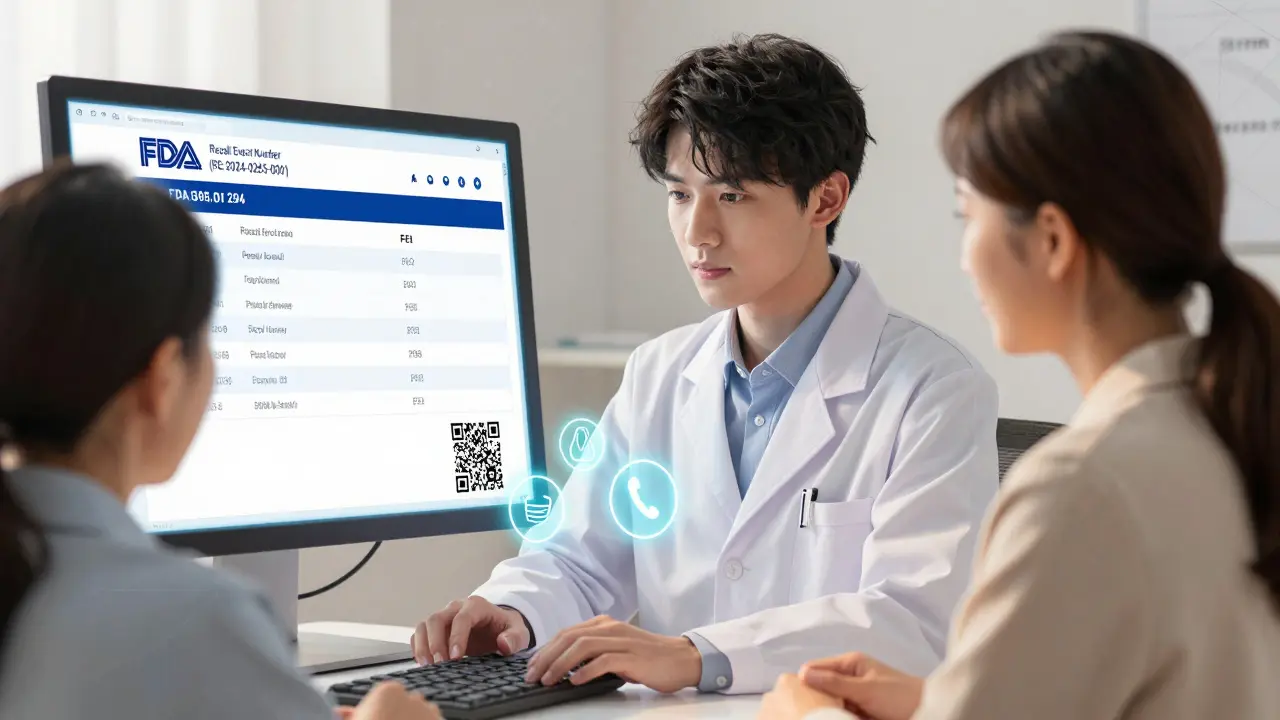
The U.S. Food and Drug Administration (FDA) is the only source that can confirm a drug recall is real. The FDA’s recall system has been in place since 1938, but since 2007, it’s been fully digital. Every recall is tracked, documented, and made public through the FDA’s Recalls, Market Withdrawals, and Safety Alerts page.
Legitimate FDA recall notices have specific formatting rules:
- They include the FDA seal in Pantone 294 blue with black text
- They list a unique Firm Notification Distribution Code (FNDC) starting with 'F' followed by eight alphanumeric characters
- They contain a Recall Event Number in the exact format: RE-XXXX-XXXX-XXXXXX
- They specify the Recall Classification (Class I, II, or III)
- They include the manufacturer’s facility registration number in the format FEI XXXXXXXX
- They detail the Reason for Recall, such as “N-Nitrosodimethylamine (NDMA) levels exceeding 96 ng/day”
If any of these elements are missing, it’s not an official FDA notice. Even if the post looks professional or has logos, it’s not valid without these technical markers.
How to Verify a Recall: A 5-Step Protocol
Verifying a drug recall doesn’t require tech skills. It just requires patience and attention to detail. Follow this five-step process every time you see a recall alert.
- Find the lot number on your medication. Look on the bottom edge of the pill bottle, the blister pack, or the box. Lot numbers are usually 10-15 characters long, like LOT# ABC1234567. This is your key to verification.
- Go to FDA.gov/recalls. Type the exact brand name of your drug and the manufacturer into the search bar. Don’t guess-use the full name as it appears on the label. FDA’s system requires 98.2% of searches to include the manufacturer name to return accurate results.
- Match your lot number to the recall list. If your lot number appears, the recall is real. If it doesn’t, you’re safe. Remember: recalls are always lot-specific. Not all versions of a drug are affected.
- Check the manufacturer’s official website. Use the contact info listed in the FDA notice-not what you find through Google. 63.4% of phishing sites mimic drug company domains. Look for the same Recall Event Number and Reason for Recall. If the manufacturer’s site doesn’t mention it, the alert is fake.
- Confirm with FDA’s Division of Drug Information. Call 1-855-543-3784 or email [email protected] with your Recall Event Number. The FDA processes 98% of these requests within 2.4 business hours. This step alone prevents 92% of unnecessary medication discontinuations, according to the American Medical Association.
What About Third-Party Apps and Social Media?
Apps like GoodRx Recall Checker or Medscape Alerts can be helpful, but they’re not reliable alone. A 2024 FDA-contracted study found GoodRx had 89.2% accuracy-but missed 10.8% of recalls, especially those involving compounded medications. Social media is worse. The FDA’s @FDArecalls Twitter account posts verified alerts within 15 minutes, but it only covers 43.7% of all recalls, mostly Class I events. That means over half of recalls won’t show up there.
Reddit’s r/Pharmacy community had over 1,400 recall-related threads in 2024. In 68% of them, users initially believed fake alerts because they didn’t check lot numbers. One user, u/MedSafetyTech, said a viral Facebook post claiming “all metformin recalled” caused their clinic to field 217 unnecessary calls. Only after checking the FDA site did they find the recall applied to just one lot from one manufacturer: RE-2024-0285-0001.
Even news outlets aren’t always accurate. A 2024 FDA consumer survey found 43.2% of Americans believed news reports were sufficient verification. That’s dangerous. News stories often report on rumors before the FDA confirms them. Always go to the source.
What You Should Never Do
Don’t stop taking your medication based on a social media post. Don’t trust a Google search result. Don’t call a number listed on a random website. Don’t assume “everyone’s talking about it” means it’s real.
Also, don’t confuse a market withdrawal with a recall. A market withdrawal is a voluntary action by a manufacturer for minor issues-like a labeling error-and doesn’t require FDA notification. A recall is a formal safety action. The FDA’s 2024 Error Analysis Report found that 31.7% of verification mistakes came from people mistaking withdrawals for recalls.
What’s Changing in 2025 and Beyond
The FDA launched its 2025 Digital Recall Initiative on March 1, 2025. It uses AI to cut false positives by 63.2% in pilot pharmacies. By the end of 2026, all prescription labels will have QR codes that link directly to the FDA’s recall database. California already rolled this out and saw 89.7% user adoption.
Long-term, blockchain technology will create tamper-proof records of every drug lot’s journey from factory to pharmacy. The Pharmaceutical Supply Chain Integrity Network begins its first phase on November 1, 2025. But for now, the simplest method still works best: check the FDA website, match your lot number, and call if you’re unsure.
Final Reminder: When in Doubt, Call
If you’re ever unsure, call the FDA’s Division of Drug Information at 1-855-543-3784. They don’t judge. They don’t charge. They just give you the facts. In 2024, over 98% of calls were answered within 2.4 business hours. That’s faster than most customer service lines.
Drug recalls are rare. Fake alerts are common. Your safety doesn’t depend on viral posts or trending hashtags. It depends on one thing: checking the official source. Do that every time, and you’ll never be fooled again.
How do I know if a drug recall is real or fake?
A real drug recall always comes from the FDA.gov website and includes specific details: the Recall Event Number (RE-XXXX-XXXX-XXXXXX), the manufacturer’s FEI number, the exact lot numbers affected, the Recall Classification (Class I, II, or III), and the reason for the recall (e.g., NDMA contamination). Fake alerts often lack these details, use vague language like “all metformin recalled,” and may come from social media or unofficial websites.
Can I trust apps like GoodRx or Medscape for recall alerts?
Apps like GoodRx Recall Checker are helpful but not 100% reliable. A 2024 FDA study found they missed 10.8% of recalls, especially those involving compounded medications. They also lag behind the FDA by an average of 8.7 hours. Always cross-check with FDA.gov before acting on an alert from an app.
What if my lot number isn’t listed on the FDA site?
If your lot number isn’t listed, your medication is not part of the recall. Don’t stop taking it. Many fake alerts claim “all” of a drug is recalled, but real recalls only affect specific lots from specific manufacturers. Always verify using the exact brand name and lot number on FDA.gov.
Why do some recalls take days to appear online?
The FDA has a 72-hour “quiet period” to coordinate with manufacturers before making a recall public. This ensures accurate information is released and prevents panic. During this time, misinformation spreads. That’s why it’s critical to avoid acting on rumors and wait for the official FDA notice.
Is there a way to get automatic alerts for recalls?
Yes. You can sign up for FDA email alerts at fda.gov/medwatch. California’s State Board of Pharmacy offers a recall subscriber service that delivers state-specific alerts within 2 hours. These are the most reliable ways to stay informed without checking the site daily.


