
Finding out you need a prescription while breastfeeding can feel overwhelming. Your first instinct might be to stop nursing entirely or throw away every drop of milk expressed during your treatment. But here is the reality: fewer than 2% of medications actually require you to stop breastfeeding. For the vast majority of us, it is just a matter of timing and organization. The goal isn't to panic; it's to manage your breast milk storage strategically so your baby stays fed and safe.
Key Takeaways for Medication Management
- Most medications are safe; only a tiny fraction require a total break from nursing.
- Strategic timing of feeds and pumping is usually more effective than a blanket "pump and dump."
- Labeling must include the medication name, dose, and exact time of administration.
- Separate your "clean" milk from "medicated" milk to avoid confusion.
- Stick to the "rule of 4s" for storage durations but adjust based on your doctor's advice.
The "Pump and Dump" Myth vs. Strategic Timing
You have probably heard the term "pump and dump." It sounds simple: pump the milk out and throw it away until the drug clears your system. However, this is rarely a medical necessity. Instead, experts suggest strategic timing. This means nursing your baby right before you take your dose, so the medication levels in your milk are at their lowest when the baby feeds.
If your doctor does recommend avoiding a specific window of time, you don't necessarily have to waste that milk. Depending on the drug's half-life (how long it stays in your body), you might be able to store that milk and use it later, or simply discard only the batches expressed during peak concentration. To do this, you need a rock-solid labeling system.
How to Label Milk When Taking Medication
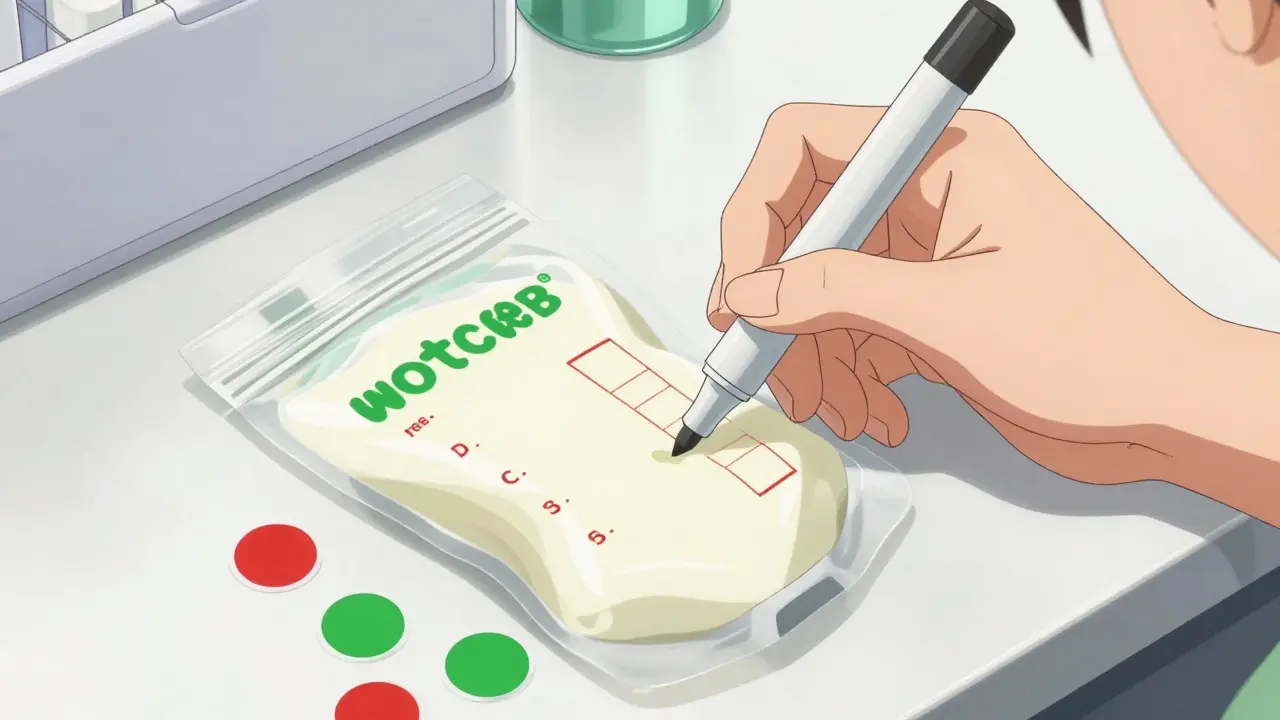
A simple date and time aren't enough when you're managing a prescription. If you glance at a freezer bag and can't remember if that was the "antibiotic batch" or the "clean batch," you're likely to throw away perfectly good milk. To avoid this, use waterproof labels and permanent ink.
Every container should include these four data points:
- Date and Time: When exactly was the milk expressed?
- Medication Name: Which drug were you taking? (e.g., Amoxicillin).
- Dosage: How many milligrams were in the dose?
- Dose Time: What time did you take the pill? This helps you calculate the peak concentration window.
A great pro tip from experienced moms is using color-coded stickers. For example, use a red sticker for milk expressed during the medication peak and a green sticker for milk expressed after the drug has cleared. This prevents the 68% of common labeling mistakes where users forget to mark the timing of their medication.
Safe Storage Guidelines and Durations
When managing medications, you should follow the core guidelines from the CDC and the Academy of Breastfeeding Medicine, but with a few extra precautions. The "rule of 4s" is your baseline: 4 hours at room temperature, 4 days in the fridge, and about 6 months (or more) in the freezer.
| Storage Location | Standard Duration | Medication Note |
|---|---|---|
| Room Temperature | Up to 4 hours | Limit to 4 hours to prevent bacterial growth. |
| Refrigerator | Up to 4 days | Use as the primary holding area for separate batches. |
| Freezer | 6 to 12 months | Freeze in 2-4 oz portions to reduce waste. |
Keep in mind that milk expands as it freezes. Don't fill your bags or bottles to the very top, or they might leak or crack. If you're traveling, an insulated cooler bag with frozen ice packs can keep your separated batches safe for up to 24 hours.
Managing Different Medication Safety Levels
Not all drugs are created equal. Many lactation consultants use a safety scale (like the one found in Hale's Medications and Mothers' Milk) to categorize risks. Understanding where your medication falls can reduce your stress.
- L1 (Safest): These medications have very low transfer into milk. You can store and label your milk normally without any special separation.
- L2-L3 (Moderate): These might require the "strategic timing" mentioned earlier. You'll want to separate milk pumped during the 2-4 hours after a dose.
- L4-L5 (High Risk): These are the rare cases where you might actually need to "pump and dump" or stop nursing temporarily. These require strict separation and immediate consultation with your provider.

Common Pitfalls to Avoid
It is incredibly common to feel confused when you're tired and dealing with a sick baby or a health issue of your own. Many parents accidentally throw away too much milk because they aren't sure about the windows of time. Remember, once milk is thawed but still cold, you still treat it according to refrigeration guidelines-don't just toss it because it was once frozen.
Another mistake is mixing "medicated" milk with "clean" milk in the same container to save space. Never do this. If you later find out a specific batch needs to be discarded, you'll end up throwing away all your good milk along with it. Keep them in separate bags or bottles, even if it means more labels to write.
Do I really have to throw away milk if I'm on antibiotics?
Usually, no. Most common antibiotics are safe for breastfeeding babies. However, you should always check with your doctor or a lactation consultant. If the medication is an L1 or L2 safety rating, you can generally continue nursing normally. If there is a concern, you might just need to pump and discard milk during the peak hour after your dose.
How do I know when the "peak concentration" of a drug is?
Peak concentration is when the drug is at its highest level in your bloodstream and, consequently, your milk. This varies by drug but often happens 1 to 4 hours after taking the dose. Your pharmacist or doctor can tell you the specific window for your medication so you can label your milk accordingly.
Can I use regular stickers for labeling?
Standard paper stickers often fall off or smudge in the freezer. Use waterproof labels or write directly on the bag with a permanent marker. If you use stickers, make sure they are designed for cold storage so the information doesn't disappear over time.
What happens if I forget to label a batch?
If you aren't sure whether a batch contains medication or not, the safest bet is to treat it as medication-affected milk. Consult your healthcare provider about the specific drug you were taking to see if the risk is low enough to use it anyway, or if it's safer to discard it.
Is it safe to freeze milk while taking temporary medication?
Yes, it is safe. Freezing doesn't change the pharmaceutical properties of the medication in the milk. The most important part is the labeling, so you know exactly what is in that bag when you thaw it weeks or months later.
Next Steps for Peace of Mind
If you've just been prescribed a new medication, start by searching the MotherToBaby database or asking your pharmacist for the drug's safety rating for lactation. Once you have that, set up your "labeling station" with markers and bags before you take your first dose.
For those who find manual labeling stressful, there are now apps that can help you track dose times and generate reminders for when to pump. Whatever system you choose, the key is consistency. By separating your batches and being specific with your labels, you can manage your health without sacrificing your breastfeeding goals.


